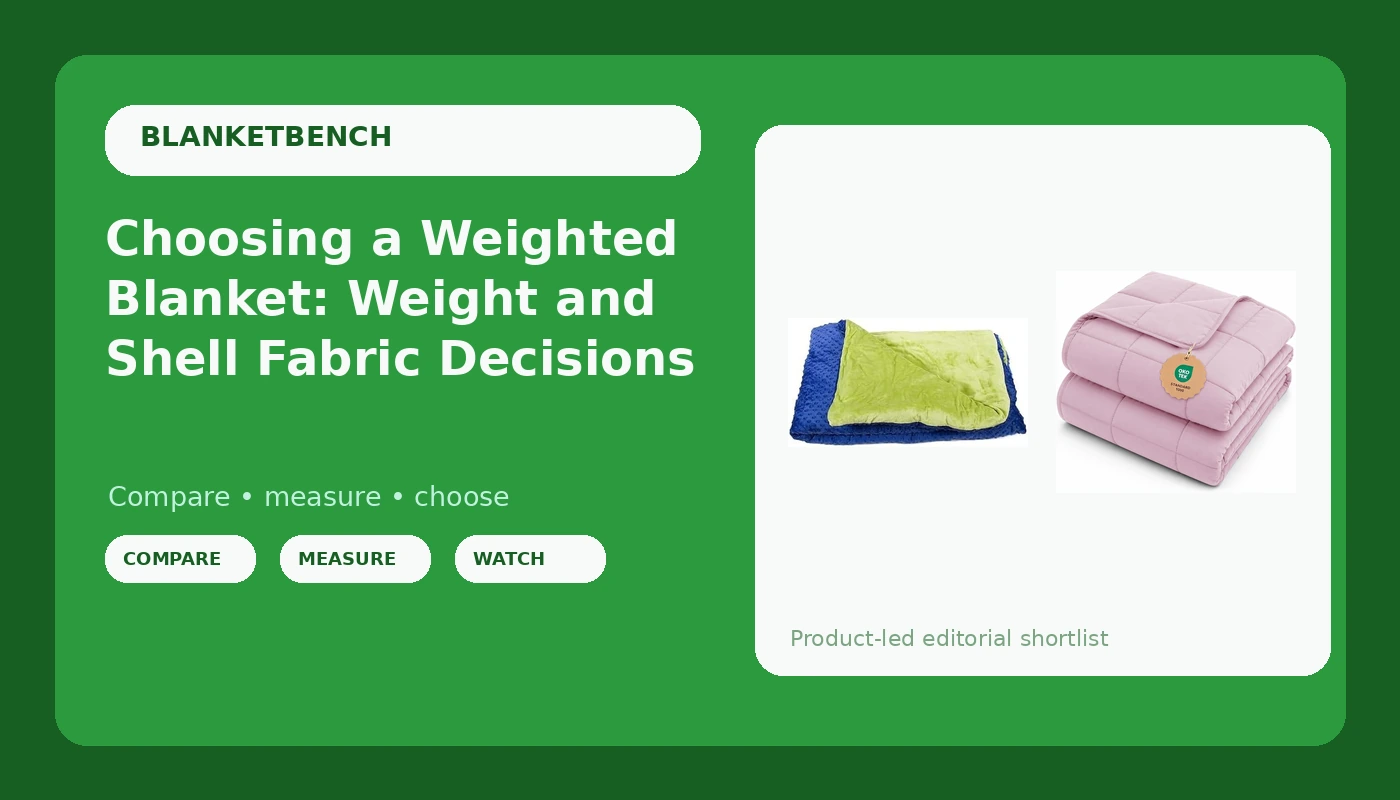
Most people shop for a weighted blanket backwards. They pick a color, they pick a brand they saw on Instagram, and then they guess at the weight. They sleep under it for a week, wake up too hot, and shove it in the closet. I have watched this happen with clients for five years, and I can usually predict who abandons a blanket within a month by asking two questions: how heavy is it, and what is the shell made of.
Knowing how to choose a weighted blanket comes down to those two things, plus a third that almost nobody checks, which is where the beads sit when you pick the blanket up by one corner. Get those three right and the blanket earns its place on your bed. Get them wrong and you have an expensive throw that lives folded at the foot of the bed for guests.
This is the same framework I use with occupational therapy clients who deal with anxiety and sensory processing, minus the clinical language.
Why you should trust me
I'm Priya, an occupational therapist in Chicago. I work with clients on anxiety and sensory processing, and I bought my first weighted blanket in 2019 out of pure insomnia, not professional curiosity. That first one was a polyester-shell brick I returned inside two weeks. Fourteen blankets later, I weigh them on a kitchen scale, check bead distribution by hand, and run a humidity sensor under the fabric to see how breathable the shell actually is.
I recommend weighted blankets to clients as part of sleep hygiene, and I say the same thing every time: the evidence is mixed, the placebo effect is real, and it still helps a lot of people fall asleep. Both of those things are true at once. What I won't do is pretend a blanket treats ADHD or autism. It doesn't. It is a sleep aid with a fabric problem.
How I picked and how I tested
This is a how-to, not a ranking. The two blankets below are here because they answer two different questions: one for adults who want a throw they can wash at home, and one for kids in a specific weight range.
I judge every blanket that comes through my office on four things: shell fabric and how it behaves in a humid Chicago summer, bead containment, stitch density at the corners, and whether the care instructions are realistic for a normal household. The failure modes are boring and predictable. Beads migrate to the edges. Stitching pops at a corner. The shell traps heat, the sleeper wakes up sweaty at 3 a.m., and the blanket never gets touched again. A blanket that needs a duvet cover to survive a wash stops getting used the first time laundry day gets busy. Weight and fabric decide, in that order.
Pick the weight first, then the fabric
The old rule is 10 percent of body weight, and it's a starting point, not a law. A 150-pound sleeper usually lands between 12 and 15 pounds. A 75-pound kid lands around 7 or 8, though plenty of kids do fine slightly heavier. The mistake I see most is overbuying. Heavier does not mean more therapeutic. It means heavier, and past a certain point it means a blanket you fight with at 2 a.m. instead of sleeping under.
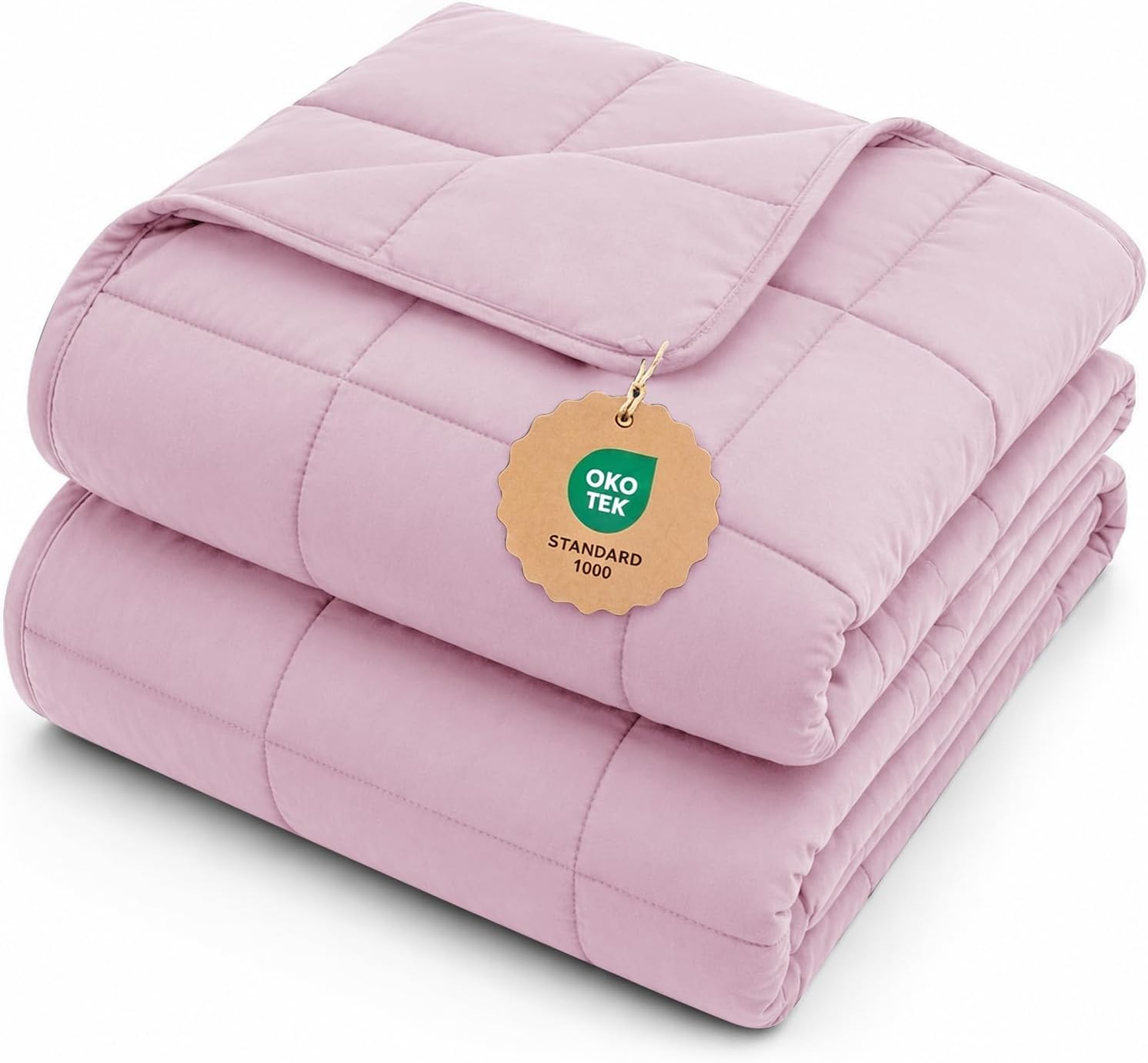
Best for adults: L'AGRATY Weighted Blanket for Adults 15lbs, 48"x72", Pink Twin Full Size Heavy Throw Blanket, Cooling, Microfiber with Glass Beads, Washable, All-Season
 Visit on Amazon →
This is a 15-pound, 48 by 72 inch blanket with glass beads in a microfiber shell. The listing describes it as cooling, breathable, all-season, and washable, and it comes in pink in a twin and full size. The 15-pound figure is the part that matters most, because it puts this squarely in the range for a sleeper between roughly 130 and 160 pounds. The 48 by 72 size is a throw on a full or queen bed and a proper cover on a twin, which makes it a personal blanket rather than a shared one. If you sleep next to someone, buy two or buy one and accept that it's yours.
Flaws but not dealbreakers: 15 pounds is genuinely heavy for someone under 120 pounds, so if you're small, size down. Microfiber is not the most breathable shell on the market, and in a warm bedroom you may notice it. The word "cooling" on a blanket box is as often marketing as it is fiber technology, so treat it as a bonus rather than a guarantee.
Anyone who wants a washable throw for a twin bed or a couch and weighs in the neighborhood of 150 pounds should start here.
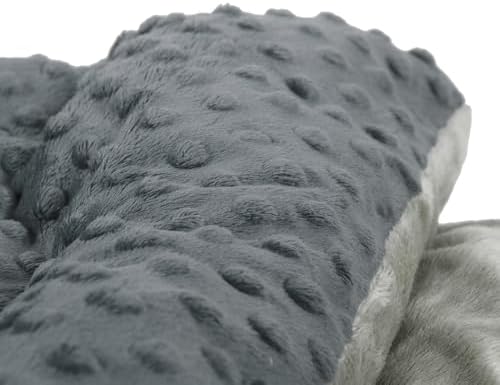
Best for kids: Harkla Kids Weighted Blanket - 10lb Cooling Weighted Blanket for Kids - Washable Minky Cover with Glass Beads - Rayon Made from Bamboo - Designed for Sensory Support (70-90lb) - Blue
 Visit on Amazon →
This one is 10 pounds, sized for kids in the 70 to 90 pound range, with glass beads, a minky cover, and a layer of rayon made from bamboo. The washable minky cover is the detail that decides whether this survives a school year. Kids spill things, and a blanket that can't go in the machine is a blanket that gets retired early. Minky is soft and it sleeps warm, so this is a better cool-weather or cool-bedroom blanket than a July one, which is worth knowing before you buy in June.
Flaws but not dealbreakers: At the bottom of that 70 to 90 pound range, 10 pounds is about 14 percent of body weight, which is heavier than the starting guideline. Some kids love that and settle instantly. Others feel pinned. The minky cover also has to go back on after every wash, and that is a two-person job on laundry day. The one rule I never bend with kids: the child must be able to move the blanket off by themselves. If they can't, it's too heavy, full stop.
Parents of a 70 to 90 pound kid who wants something soft, washable, and sensory-friendly in feel should look here first.
The actual how-to: seven steps
Step one: weigh the person, not the blanket. Start at 10 percent of body weight, then adjust up or down. A 150-pound adult starts at 15 pounds. A 75-pound kid starts at 7 or 8. If you're between two weights, go lighter first. You can always add a second layer, but you can't subtract beads.
Step two: size the blanket to the bed. A 48 by 72 blanket is a throw on a queen and a cover on a twin. Weighted blankets work by concentrating weight over your body, and if you buy a blanket that's smaller than your sleeping footprint, half of it ends up on the floor doing nothing. Measure your mattress before you order.
Step three: pick the shell for your climate. Bamboo, cotton, and minky behave very differently from polyester. Bamboo and cotton breathe, which matters in a Chicago July with the window unit struggling. Minky is cozy and warm. Polyester traps heat and turns into a sauna. If you sleep hot, this one decision will matter more than the brand on the tag.
Step four: test the bead distribution. Pick the blanket up by one corner and hold it. If the weight slides down and pools in the bottom, put it back. A well-made blanket keeps its beads in small quilted squares or channels so the weight stays where it belongs. A blanket that dumps its weight into the middle is a sack of potatoes on your chest, and you will feel it in your ribs by morning.
Step five: check stitch density at the corners. Corners are where stitching pops first, because that's where the fabric gets pulled hardest. Look for small channels and reinforced corners. This is the single most common failure I see in cheap blankets, and it usually shows up around month two.
Step six: confirm it can go in your machine. Read the care instructions before you buy, not after. If a blanket requires a duvet cover to survive a wash, or dry cleaning, walk away. In my experience, washability decides whether a blanket is still on the bed in a year. The clients who keep theirs are the ones who can toss it in on a Saturday.
Step seven: give it two weeks, and treat it as one piece of a routine. A weighted blanket provides proprioceptive input, that deep-pressure feeling that calms some nervous systems. It works best alongside a consistent bedtime, a dark room, and less screen time before bed. It is not a cure for insomnia, and if you expect one, you'll be disappointed by week three.
Who should not use one
Infants and toddlers should not use weighted blankets at all. Neither should anyone who can't remove the blanket themselves, whether that's a young child or an adult with limited mobility. If you're pregnant, talk to your provider before you buy. And I want to be clear about something the marketing rarely is: a weighted blanket is not a treatment for ADHD or autism. I work with those populations and I'll still say it. It can be a comforting sleep tool for some people in those groups, and that is a different claim.
If you have sleep apnea or a respiratory condition, ask a clinician first. Weight on the chest is not neutral for everyone.
One more thing: don't chase the heaviest blanket you can find. I've seen a 200-pound man sleep beautifully under 12 pounds. The number on the box is not a score.
What I left out and why
The big sleep brands with the glossy design language make fine blankets, and I understand the appeal. But in my experience the fabric quality at the middle of the market is often comparable, and the premium is frequently for branding and the word "therapeutic" printed on a box. If a blanket fits your weight, breathes in your bedroom, keeps its beads in place, and can be washed at home, it has done its job.
The two blankets above cover the adult throw and the kid-sized option. If you're shopping for a couple, or for a bed bigger than a twin, you're looking for a different size class than either of these.
What this all costs
Frame it per night, because that's the honest math. A blanket you use every night for three years costs pennies a night. A blanket you abandon in a month costs the same money and returns nothing but closet space. That's why I push fabric and washability so hard. The abandonment problem is the whole problem.
The middle of the market is where the real quality lives. Below it, beads shift and stitching pops. Above it, you're paying for branding. You don't need to spend the most to sleep well. You need the right weight, a shell that breathes, beads that stay put, and a care tag that says machine washable.
Start at 10 percent, adjust from there, and buy the fabric for the bedroom you actually sleep in. That's the job, and it takes about ten minutes to get right.