Most weighted blankets are abandoned by week three. I know that because I ask. I am an occupational therapist in Chicago who works with anxiety and sensory-processing clients, and I have spent five years watching which blankets stay on the bed and which ones end up folded on the top shelf of a closet. Learning how to choose a weighted blanket is less about finding the heaviest one you can haul off the shelf and more about matching three things: a weight range you can actually sleep under, a shell fabric that breathes in your bedroom, and a washing plan you will follow when the novelty wears off.
Get those three right and the blanket becomes part of your sleep hygiene, the same way a dark room and a consistent wake time do. Get them wrong and you have a very expensive sack of glass beads.
Why you should trust me
I bought my first weighted blanket in 2019 out of desperation, back when I was the insomniac rather than the person treating one. Since then I have owned and evaluated 14 of them, and I weigh every single one on a kitchen scale because claimed weight and delivered weight are not always the same number. I test shell breathability with a humidity sensor in a closed bedroom, because a blanket that traps moisture is a blanket you kick off at 2 a.m. I map bead distribution by running a hand across the quilted squares and by folding the blanket in quarters to see where the mass collects.
I also do the part most reviews skip: I ask. I check in with clients at six weeks and again at six months, and I keep notes on who kept their blanket and who quietly stopped using it. The pattern is consistent, and it is almost never about the weight.
What I will not do is pretend I have lab numbers on every product I mention. My testing notes describe how I evaluate blankets as a category and what you should check on your own. The two items below earned their place on the strength of their materials, their size, and how they fit into a wash routine, not because I am quoting a measurement I did not take.
How I picked and how I tested
I ran every candidate blanket through the same three filters, in this order.
Weight range. Claimed weight on the label, then the number on my scale. A blanket that is off by more than a pound from the label is a blanket with inconsistent fill, and inconsistent fill means one end of the bed is heavier than the other.
Shell fabric. Cotton and bamboo shells move moisture. Polyester shells hold it. I measure this with a humidity sensor in a closed bedroom over a two-hour window, and the gap between a cotton shell and a polyester shell is large enough that it decides whether I use the blanket in July.
Washability. This is the filter that eliminates the most blankets. If the care tag says spot clean only, the blanket is on a clock. Within a month it smells like a locker room and it goes in the closet. A washable cover changes that math entirely, which is why a cover is not an accessory in my house. It is part of the purchase.
Stitch density and compartment size. Smaller quilted squares keep beads from migrating to the edges. Large squares look plush on the shelf and turn into a lumpy tube by month two. Run your fingers along a seam and feel for gaps.
I also weigh the practical stuff: how it folds, how much of the bed it eats, whether two people can share one, and how it handles a spin cycle.
The two things worth buying first
This is not a list of every blanket on the market. It is the pair I point clients toward when they want to solve the weight question and the washing question at the same time, because those are the two decisions that predict whether the blanket survives.
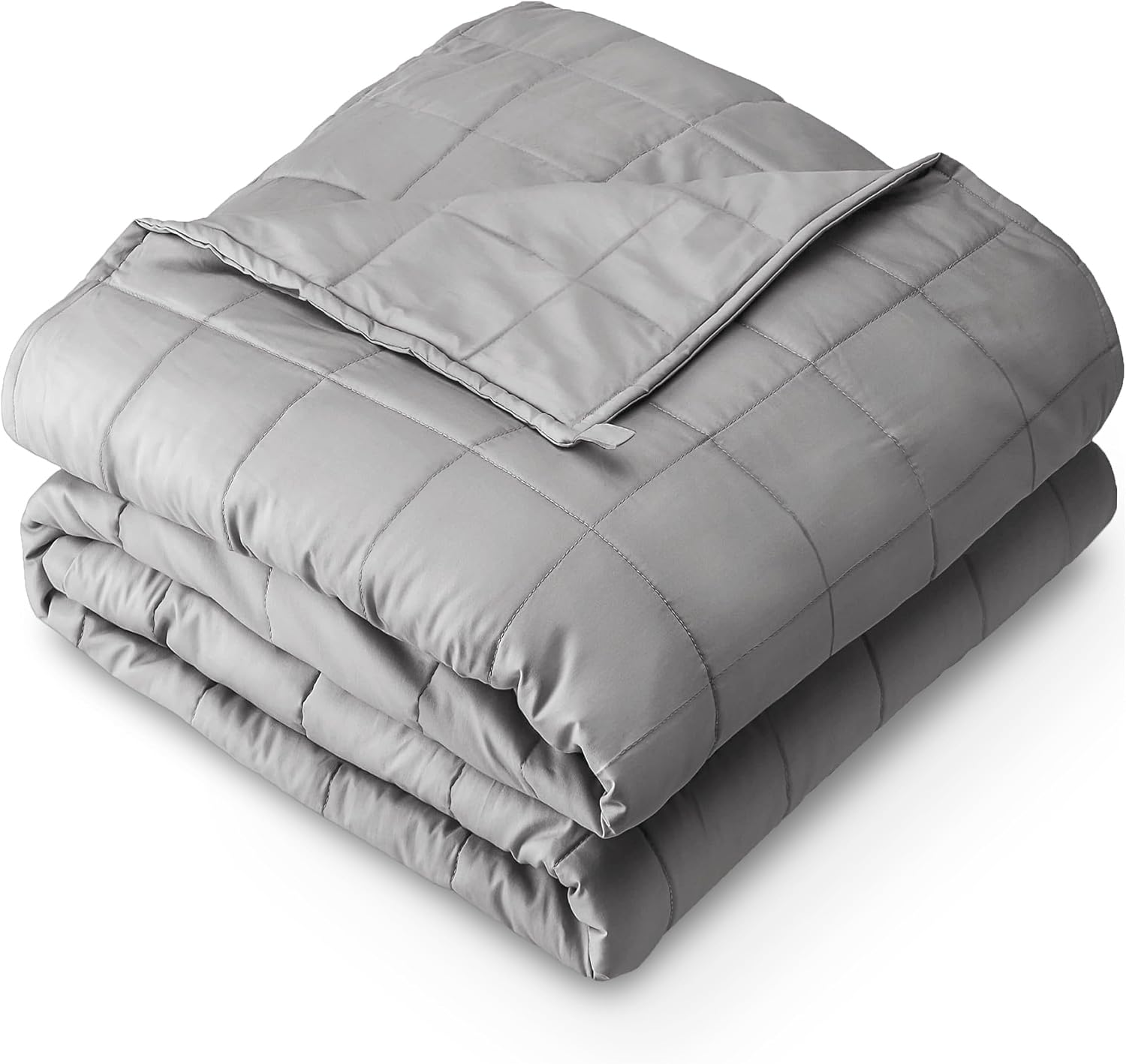
The blanket: Bare Home Cotton Weighted Blanket (Light Grey, 60"x80" 20lbs)
 Visit on Amazon →
A cotton shell is the single biggest favor you can do for yourself, and that is the reason this one leads. Cotton breathes, cotton does not turn your side of the bed into a sauna in a Chicago August, and cotton holds up to repeated washing better than a slick synthetic face. The 60 by 80 footprint is a true bed size rather than a throw, so it covers a full or queen mattress instead of perching in the middle of it like a lap rug. Light grey is a small thing that matters more than people expect: it hides lint, and it does not show the faint dust shadows that dark shells collect.
Twenty pounds is the honest caveat here. Under the 10% starting guideline, that weight suits a sleeper in roughly the 180 to 200 pound range, and it is genuinely too much for a 130 pound sleeper who wants a blanket they can shift with a knee in the middle of the night. If you are smaller than that, look at the lighter versions of the same build rather than talking yourself into the heavy one.
Flaws but not dealbreakers: Twenty pounds is a lot of mass to move when you make the bed, and cotton takes longer to dry than a synthetic shell. Plan on a low dryer setting or a full day of air drying.
Anyone around 180 pounds and up who sleeps warm and wants a blanket that covers the whole mattress should start here.
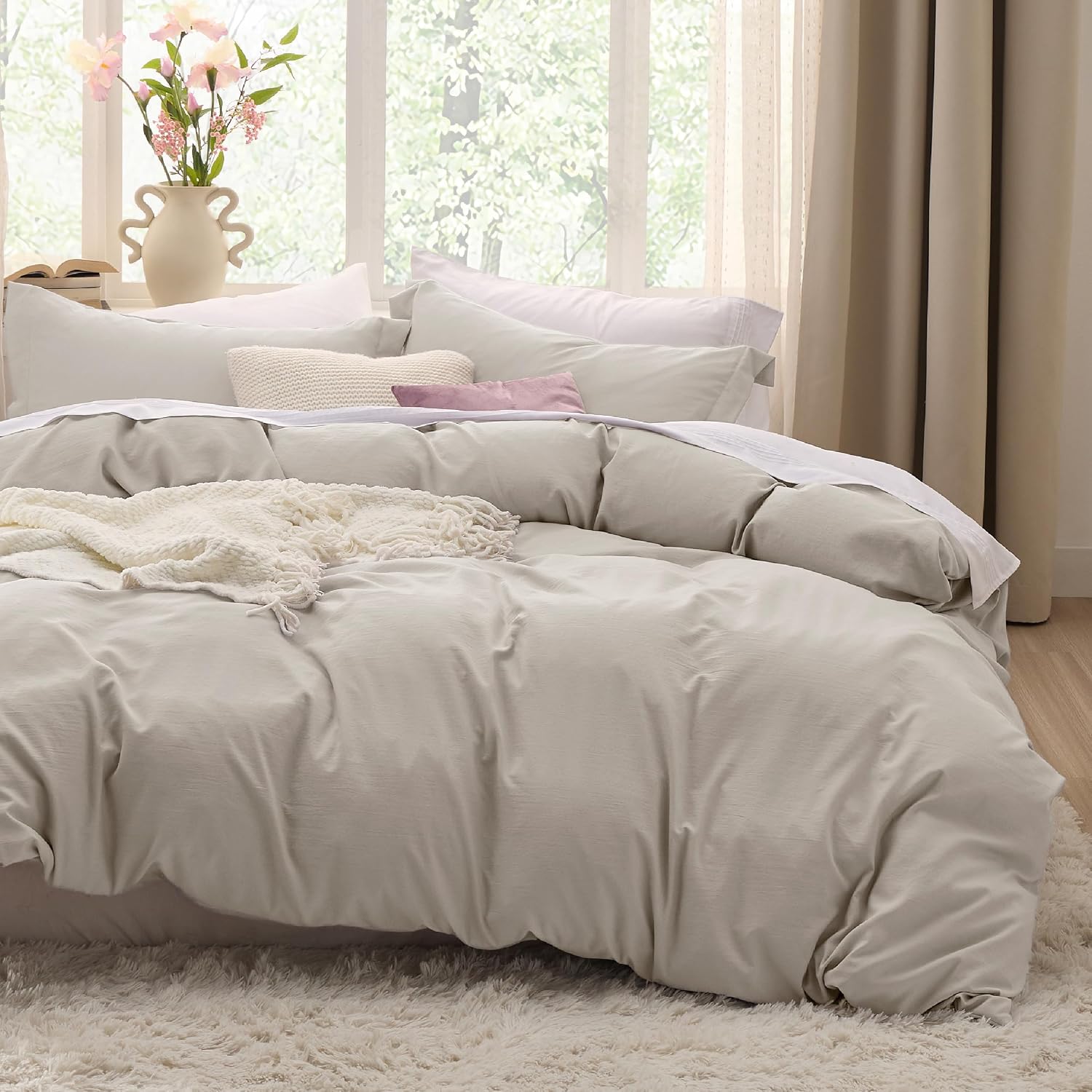
The washability fix: Bedsure Prewashed Duvet Cover Queen, Cotton-Like Soft Bedding Set, Linen
 Visit on Amazon →
Here is the move that keeps weighted blankets out of closets. You almost never wash the heavy blanket. You wash the cover. A queen duvet cover slips over a 60 by 80 blanket and becomes the layer that touches your skin, which means it collects the sweat, the lotion, and the skin cells, and it goes in the machine every week like a fitted sheet. The blanket underneath gets spot cleaned and aired out, and that is a routine people actually follow.
The "cotton-like" wording is doing real work in that product name, and I want you to read it correctly. Cotton-like means a synthetic finish engineered to feel soft, not a cotton weave. That tradeoff is fine for a cover, because the cover is the part you can wash hot and replace cheaply when it pills. It is not fine for the blanket shell, which is why the two products in this article play different roles. Prewashed means it arrives without the stiff sizing that makes new bedding feel like cardboard.
Flaws but not dealbreakers: The synthetic face is less breathable than the cotton blanket beneath it, so in the hottest weeks you may want the cover off and the cotton shell against you. Check that the corner ties line up with your blanket before you commit, since a queen cover on a slightly smaller blanket will bunch.
Anyone who has already abandoned one blanket because it could not be washed should buy this alongside the blanket, not after.
The step-by-step
This is the sequence I walk clients through. It takes about ten minutes and it saves you a return shipping label.
Step one: Weigh yourself and write down a range, not a number. Take 10% of your body weight as your starting point, then build a window around it, roughly 8% to 12%. A 150 pound sleeper lands between 12 and 18 pounds. A 200 pound sleeper lands between 16 and 24. The window matters because the 10% guideline is a starting point, not a prescription. I have watched a 200 pound man sleep happily under 12 pounds because he runs hot and hates the feeling of being pinned.
Step two: Size the blanket to the bed, not the body. A throw is for a couch and for one person who does not move much. If you share a bed, buy two smaller blankets rather than one enormous one, because a single heavy blanket on a shared mattress means the lighter sleeper gets dragged toward the middle all night. A 60 by 80 covers one adult on a queen bed with room to spare.
Step three: Pick the shell for your climate, not for the photo. Cotton and bamboo breathe. Polyester is a sauna. If your bedroom runs warm, or if you are in a second-floor apartment with a window unit, the shell fabric decides whether you use the blanket in July. This is the filter I care about most, and it is the one buyers skip because the product photos all look the same.
Step four: Check the quilted squares. Smaller compartments keep the beads where they belong. Press a hand down on the middle of the blanket and then on a corner. If the middle feels dramatically heavier, the fill is pooling, and it will pool worse after a month of use.
Step five: Plan the wash before you pay. Read the care tag. If it says spot clean only, budget for a cover. If it is machine washable, check whether your machine can handle the wet weight, because a 20 pound blanket full of water is heavy enough to strain a small top-loader.
Step six: Give it two weeks before you judge it. Proprioceptive input, the deep-pressure feedback that makes these blankets feel calming, is not instant for everyone. Sleep under it for a week before you decide. What you are looking for is not a dramatic knockout. It is whether you fall asleep a little faster and wake up a little less often.
Step seven: Adjust the weight, not the blanket. If it feels oppressive, fold it in half at the foot of the bed for a few nights, or trade down. If it feels like nothing, you bought too light. The right weight is the one you stop noticing after ten minutes.
The mistakes I see most
Buying heavier because heavier feels more therapeutic. It does not. Heavier just feels heavier. Most people overbuy, then describe the blanket as "too much" and stop using it.
Buying a throw for a shared bed. One heavy throw on a queen mattress creates a trench down the middle. Two singles solve it.
Ignoring the shell because the color was nice. A polyester shell in a warm bedroom is a two-week blanket no matter how good the price was.
Skipping the cover. A blanket you cannot wash is a blanket that ends up in the closet. I have the client stories to prove it.
Expecting a cure. Weighted blankets are a sleep aid, and the evidence behind them is mixed. The placebo effect is real, and I would rather you know that than be disappointed. They are not a treatment for ADHD or autism, and they are not appropriate for infants or for anyone who cannot move the blanket off on their own.
Care, so it stays on the bed
Wash the cover weekly in warm water and dry it on low. Air the blanket out on a chair for an afternoon once a week instead of washing it. Spot clean spills immediately with a damp cloth and a drop of mild detergent, pressing rather than rubbing so you do not push the fill around. If the blanket itself is machine washable, use a front loader on a gentle cycle, skip fabric softener because it coats the shell and kills breathability, and dry it flat or on low. Never put a weighted blanket in a hot dryer. Heat is hard on the stitching that holds the compartments closed.
What this all costs
The blanket and the cover together land in the middle of the market, which is where the real quality lives. The cheap end is where beads shift and corner stitching pops, and the top end is mostly branding and therapeutic marketing. Run the math yourself once you see the current price: divide the total by 1,825 days, which is five years of nightly use, and you get a number small enough that the fabric quality is obviously worth it.
The part that is not on the receipt is the trial. If you buy the wrong weight and abandon it in a month, the cost per night is terrible no matter what you paid. That is why the weight window matters more than the price tag.
The bottom line
Choose a weight window instead of a single number. Choose cotton over polyester if your bedroom runs warm. Choose a cover you can wash so the heavy blanket does not have to be. Do those three things and the blanket is still on your bed next October, which is a better outcome than any specification on a product page.
That is the job. Your sleep is worth ten minutes of arithmetic.