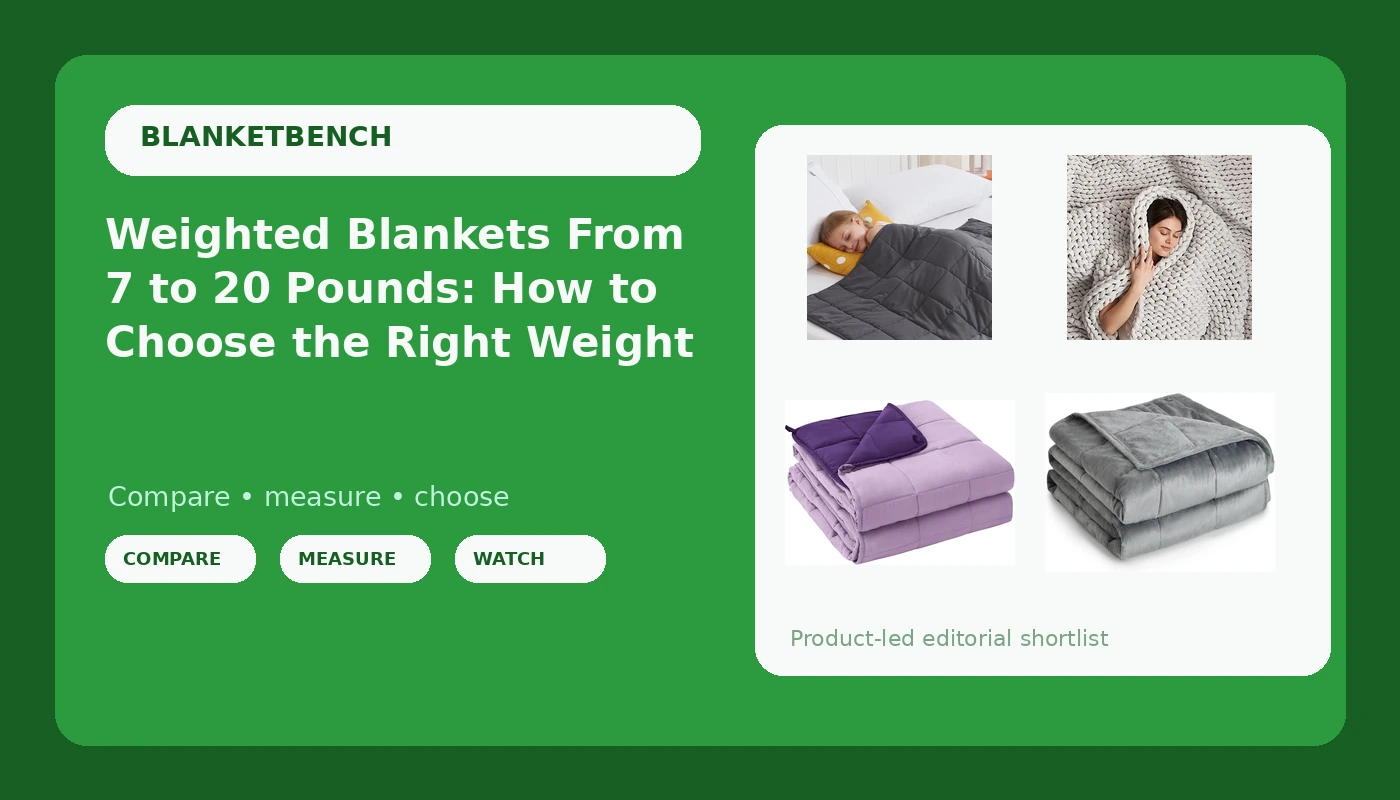
Most people looking for how to choose a weighted blanket start with a single number: 10 percent of body weight. That number is a starting point, not a rule, and treating it as a rule is exactly how a decent blanket ends up folded on a closet shelf by week three. Weight matters, but it is only one of four decisions. The others are size, shell fabric, and whether the blanket can survive a washing machine. Get the weight right and the fabric wrong, and you will sleep hot for a week and then quit. Get the fabric right and the weight slightly off, and you will probably keep using it. The four blankets below cover a wide spread, from 7 pounds to 20 pounds, and each one solves a different part of the problem.
Related: Weighted Blanket Weight Chart: Matching Pounds to Body Weight →
Quick answer
A weighted blanket tends to feel right when its weight falls somewhere between roughly 8 and 12 percent of your body weight, and when it is sized to your body rather than to your mattress. Start in the middle of that range, not at the top, because heavier mostly just feels heavier. The research on weighted blankets is mixed, and much of what people describe comes from the calming effect of deep pressure, so treat weight as a comfort setting you can adjust rather than a prescription. Among the options here, the Topblan 15 lb twin is the middle-of-the-road adult pick, the CuteKing 7 lb is the lightest and smallest, the Bearaby 10 lb is the hand-knit and machine washable one, and the yescool 20 lb queen is the heaviest and largest.
Four useful options
| Model | Best fit | What stands out |
|---|---|---|
| Topblan Weighted Blanket Twin Size 15lbs, 48 x 72 for Adults | One adult who wants a mid-weight solo blanket | 15 lb fill in a 48 x 72 inch twin footprint |
| CuteKing Weighted Blanket (7lbs, 40"x 60", Grey) | A 60 to 80 pound sleeper, or an adult who wants a light lap blanket | 7 lb glass bead fill in a 40 x 60 inch size |
| Bearaby Cotton Hand-Knit Weighted Blanket (Moonstone Grey, 10 lbs, 40"x64") | Hot sleepers who want an open, breathable, washable blanket | Hand-knit cotton, 10 lbs, 40 x 64 inches, machine washable |
| yescool Weighted Blanket for Adults 20lbs Queen Size, 60" x 80", Purple | Full-bed coverage on a queen mattress, or someone who knows they like heavy | 20 lb fill in a 60 x 80 inch queen footprint |
The mid-weight default: Topblan Weighted Blanket Twin Size 15lbs, 48 x 72 for Adults
The trade-off here is coverage, not weight. A twin blanket on a queen or king mattress covers the person, not the bed, which is fine if you sleep alone and annoying if you do not. If you share a bed, the usual answer is two blankets in two different weights rather than one compromise blanket that is wrong for both sleepers. Before buying, read the listing for fill material and shell fabric details, because those two things decide how warm the blanket sleeps and how well the weight stays put.
The lightest option: CuteKing Weighted Blanket (7lbs, 40"x 60", Grey)
This is the entry where safety matters more than preference. For a 60 to 80 pound child, 7 pounds lands around 9 to 12 percent, which is in range, but the rule that matters more is that the child can lift and move the blanket off without help. Weighted blankets are not for infants, toddlers, or anyone who cannot free themselves, and they should never be used as a cover for a small child sharing a bed. For an adult, 7 pounds is a lap blanket or a very light option for someone who wants pressure without heat. Be honest about which of those two buyers you are.
The hand-knit option: Bearaby Cotton Hand-Knit Weighted Blanket, 10 lbs, 40"x64"
Washability decides whether a blanket gets used for years or abandoned in a month, and this is the one on the list that says outright it can go in a machine. That matters more than most buyers expect, because a blanket that needs a duvet cover to survive cleaning is a blanket that slowly stops getting used. The trade-offs are real too: hand-knit cotton is a different price tier than a bead-filled blanket, and an open knit structure is not the right choice for a household with cats that knead or dogs that dig. If you sleep hot and you want something you can clean without a fight, this is the shape of the answer.
The heavy queen option: yescool Weighted Blanket for Adults 20lbs Queen Size, 60" x 80", Purple
Run the percentage before you commit to 20 pounds. For a 180 pound sleeper that is about 11 percent, comfortably in range. For a 130 pound sleeper it is over 15 percent, which is heavier than the guideline suggests and may feel like work to move. Heavier also means warmer, because there is simply more material on top of you, and it means repositioning the blanket at 3 a.m. takes more effort. If you share a queen bed with a partner, remember that a single queen blanket covers the mattress but still gives both sleepers the same weight.
Prices and availability may change. Product images, names, and retailer links are matched to verified listings. No current price, rating, stock status, or measured result is stated here without current evidence.
Why weight is a range, not a rule
The 10 percent guideline is a starting point borrowed from clinical practice, not a law of physics. It exists because deep pressure input, the steady firm contact a weighted blanket provides, seems to calm some nervous systems, and because most people find a weight in that neighborhood comfortable. What the research actually shows is mixed. Some studies find small improvements in sleep onset and anxiety, others find effects that are hard to separate from placebo, and the honest summary is that this is a sleep aid that works well for some people and does nothing for others.
That is why the range matters more than the number. A 200 pound sleeper may be happiest at 12 pounds, and a 140 pound sleeper may prefer 20. Start somewhere between 8 and 12 percent, sleep with it for two weeks, then adjust. If you wake up feeling pinned down or you are throwing the blanket off at 2 a.m., you went too heavy. If you barely notice it, you went too light. The adjustment is the point, and it is cheaper to get it right by choosing a middle weight first than by buying the heaviest blanket available and hoping.
Fabric, stitch density, and washability
Shell fabric decides whether you keep using the blanket, and it is the specification buyers skip most often. Cotton and bamboo shells breathe, which matters if you sleep warm or your bedroom runs hot in summer. Polyester shells trap heat, and a polyester shell over glass beads is the classic recipe for a blanket that gets abandoned in July. Breathability is not a marketing detail; it is the difference between a blanket you reach for and one you dread.
Construction matters just as much. Bead distribution depends on how the blanket is compartmentalized: smaller quilted sections hold fill in place, and larger sections let it migrate toward the edges over time. Stitch density at the seams and corners is where cheap blankets fail first, usually with a pop at a corner and a slow leak of beads after that. If a listing shows a grid pattern with many small compartments and reinforced edges, that is a good sign. If it shows wide channels and thin stitching, expect shifting.
Then there is washing. A blanket you cannot clean is a blanket that ends up in a closet, and duvet covers add a step that most people stop doing within a month. Machine washable, on its own, is a meaningful feature.
- Weigh yourself and set a starting range of roughly 8 to 12 percent, then pick a blanket near the middle.
- Match the size to your body, not the mattress, unless you specifically want full-bed coverage.
- Choose the shell fabric for your bedroom temperature first and your decor second.
- Confirm the blanket is machine washable, or accept that you are committing to a duvet cover.
- Look at the compartment pattern and the stitching at the corners before you buy.
What to do in your first two weeks
- Sleep with it for at least five nights before you judge it. The first night is not representative.
- Try it over a sheet first, then directly on top of you, to see which feels better.
- Keep the room cool for the first week so you can separate the feeling of weight from the feeling of heat.
- If you wake up overheated, that is a fabric problem, not a weight problem, and swapping the blanket is the fix.
- If you wake up feeling trapped, drop 3 to 5 pounds rather than quitting on weighted blankets entirely.
Which option should you choose?
Choose the Topblan Weighted Blanket Twin Size 15lbs, 48 x 72 for Adults when you sleep alone, want a mid-weight blanket, and have no strong preference yet. Choose the CuteKing Weighted Blanket (7lbs, 40"x 60", Grey) when you are buying for a 60 to 80 pound child who can move the blanket off without help, or when you want a light lap blanket for an adult. Choose the Bearaby Cotton Hand-Knit Weighted Blanket (Moonstone Grey, 10 lbs, 40"x64") when you sleep warm, you want something machine washable, and you are willing to pay for the fabric rather than the fill. Choose the yescool Weighted Blanket for Adults 20lbs Queen Size, 60" x 80", Purple when you want coverage across a queen mattress and the percentage math puts 20 pounds in range for your body weight.
A caveat worth stating plainly: weighted blankets are a comfort tool, not a treatment. The evidence is mixed, placebo effects are real, and none of these blankets replaces therapy, medication, or a sleep evaluation. They are also not appropriate for infants, toddlers, or anyone who cannot remove the blanket independently, and they are not something to use during pregnancy without checking with a clinician first.
The bottom line
The blanket you keep is the one whose fabric suits your bedroom and whose weight suits your body, and those two things matter more than brand or price tier. Start near the middle of the 8 to 12 percent range, size the blanket to the sleeper rather than the mattress, and check washability before anything else, because a blanket that cannot be cleaned will not last. If you want the simplest adult starting point, the 15 pound Topblan twin is it. If you sleep hot and want to wash it without a cover, look at the hand-knit Bearaby. If you need full queen coverage, the yescool 20 pound blanket is the largest option here, and the CuteKing 7 pound blanket is the right shape for a child in the 60 to 80 pound range.