Most people learn how to choose a weighted blanket from a single sentence: buy 10% of your body weight. That sentence is the reason so many blankets end up folded on a closet shelf by week three. I am Priya, an occupational therapist in Chicago. I work with anxiety and sensory-processing clients, and I bought my first weighted blanket in 2019 out of pure insomnia.
Five years and 14 blankets later, here is what I know. Weight is a range, not a rule. Fabric is the product, not the beads. And washability decides the outcome more than anything printed on the box. Get those three things right and the blanket stays on your bed. Get them wrong and you own a very heavy throw pillow.
So this is the order that matters: shell fabric first, bead distribution second, weight third, and the care routine last. Everything else is marketing.
Why you should trust me
I am an occupational therapist who uses proprioceptive input with clients every week, and I am also the person who put every blanket in her house on a kitchen scale to see how far the listed weight drifted from the real one. Fourteen blankets over five years. I track which ones clients keep and which ones come back to me with a polite "thanks, but no."
I will be honest about the evidence, because you deserve that: it is mixed. Weighted blankets help some people settle faster and feel calmer. The placebo effect is real and I do not pretend otherwise. What I can tell you with confidence is which construction choices make a blanket pleasant to sleep under for two years, and which ones make it a chore by week two.
I also have hard boundaries. A weighted blanket is not a treatment for ADHD or autism. It is a sleep aid, nothing more. It is not for infants, and it is not for anyone who cannot lift it off themselves in the night.
How I picked and how I tested
My testing routine for a blanket has four parts, and none of them require a lab.
First, the scale. I weigh every blanket on a kitchen scale, in sections if it is too big to fit, and compare the total to the claimed number. A blanket that runs two pounds light on a 15-pound claim is a blanket with less fill than the grid was designed for.
Second, the shake test, which I will walk you through below. It tells you whether the fill stays where it is sewn or migrates to the corners.
Third, breathability. I have run a small humidity sensor inside the shell of blankets overnight to see how much moisture builds up under the fabric. Polyester shells trap it. Cotton and open weaves move it.
Fourth, the wash log. I keep a dated list of how each blanket handled its first three wash cycles, because that is when stitching fails and beads escape.
The two blankets I am pointing you toward below are the ones I would put in front of an adult sleeper right now based on construction and category. I will tell you exactly what to verify on each before you commit, because the listing page will not tell you.
The weight question, answered without the gospel
The 10% guideline is a starting point, not a prescription. I have watched a 200-pound man sleep beautifully under a 12-pound blanket and a 130-pound client fight a 15-pound one all night. Body weight is a rough proxy for what a person tolerates. It is not a formula.
Here is how to land on your number:
Start at roughly 10% of your body weight. Live with it for a week before you judge it.
If you wake up in the night pushing the blanket off, it is too heavy. Drop two or three pounds, or move it down to your legs only.
If you forget it is there after ten minutes, it is too light for you. Go up a step.
If you sleep on your side and the blanket pins your shoulder so you cannot roll, it is too heavy. This is the single most common mistake I see. Heavier feels more therapeutic. It just feels heavier.
A 15-pound blanket in a true adult size is the middle of the road, which is why both blankets below sit there. For most adults between 130 and 200 pounds, 15 pounds is a reasonable first attempt and a reasonable place to stop.
Fabric is the product, so check the shell before the beads
In a Chicago summer, fabric decides whether you use the thing. A polyester shell over glass beads is a sauna with a zipper. Cotton, bamboo, and open weaves breathe. That is the whole argument.
Three things to look at in the listing photos and the spec text:
The weave. Waffle, muslin, and loose cotton weaves move air. Tight microfiber and satin do not, no matter what the copy says about "cooling technology."
The quilting pattern. Small grids keep beads close to where they were sewn. Giant squares give beads a long runway to slide.
The care instructions. If the shell requires dry cleaning or a duvet cover to survive a wash, you have found a blanket that will be abandoned. I have the client stories to prove it.
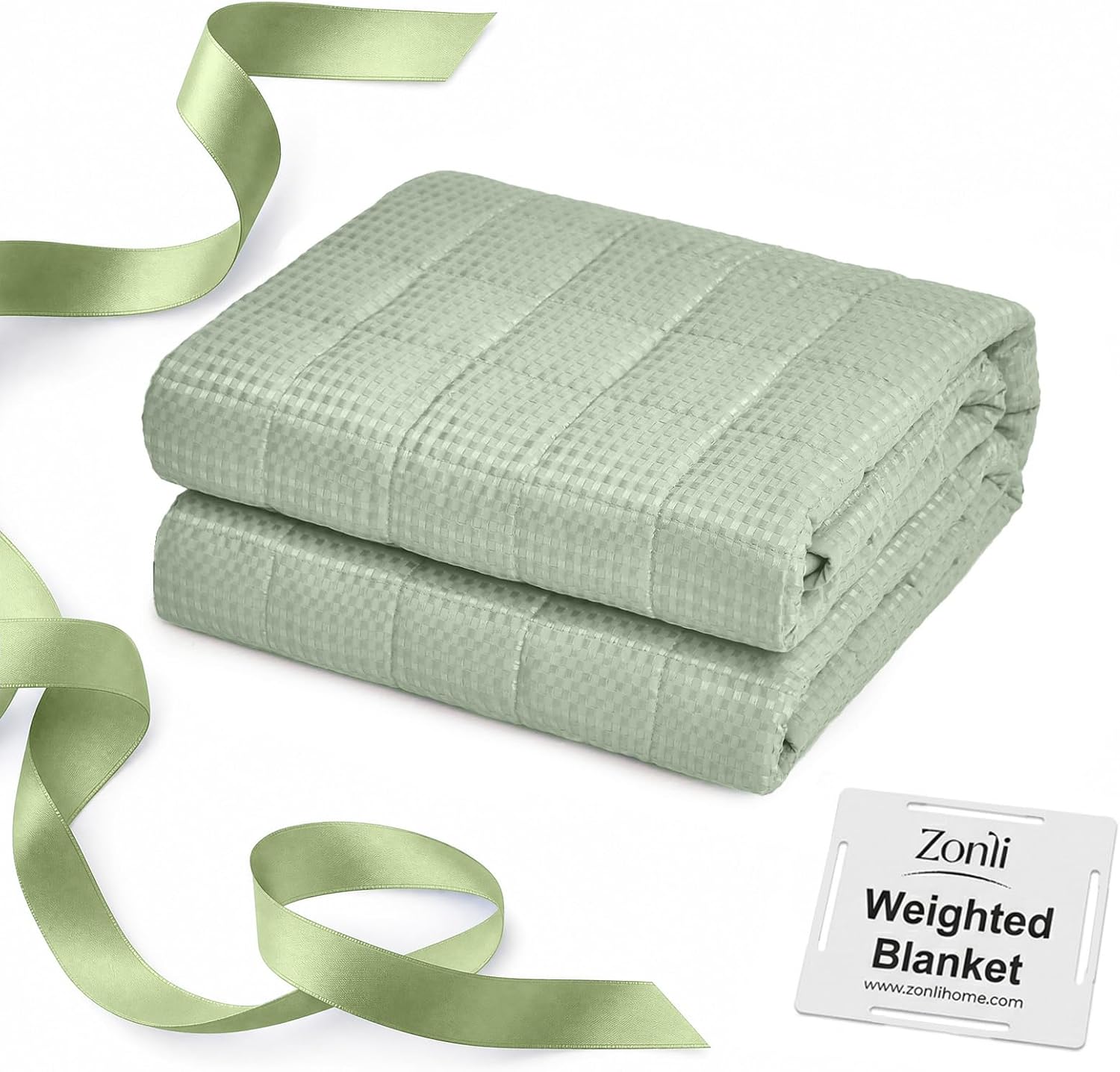
Fabric-first pick: ZonLi Waffle Weighted Blanket for Adults, Small-Grid Quilted, 60x80, 15lbs
 Visit on Amazon →
This is the construction I reach for first when someone tells me they sleep hot. The waffle weave is an open, textured weave, which gives moisture somewhere to go instead of sitting against your skin. The small-grid quilting is the detail that matters most, because short bead travel distance is the difference between a blanket that stays flat for years and a blanket that develops a heavy belly by month two. The size listed is 60 by 80 inches, a genuine adult size rather than a throw pretending to be one, and the weight listed is 15 pounds.
Before you commit, do two things. Read the care section of the listing in full, since an open weave that cannot go in a machine is a blanket with a short life in most homes. And zoom in on the quilted grid in the product photos. Count the squares across the width. More, smaller squares is what you want.
Flaws but not dealbreakers: Open weaves show stains and pulls more readily than a tight synthetic shell, so keep it away from pets with claws. And a waffle texture feels different against skin than a smooth shell does. Some people love it, some people want a flat sheet underneath.
Anyone who runs warm, sleeps in a bedroom without strong air conditioning, or has abandoned a weighted blanket before because it felt suffocating should start here.
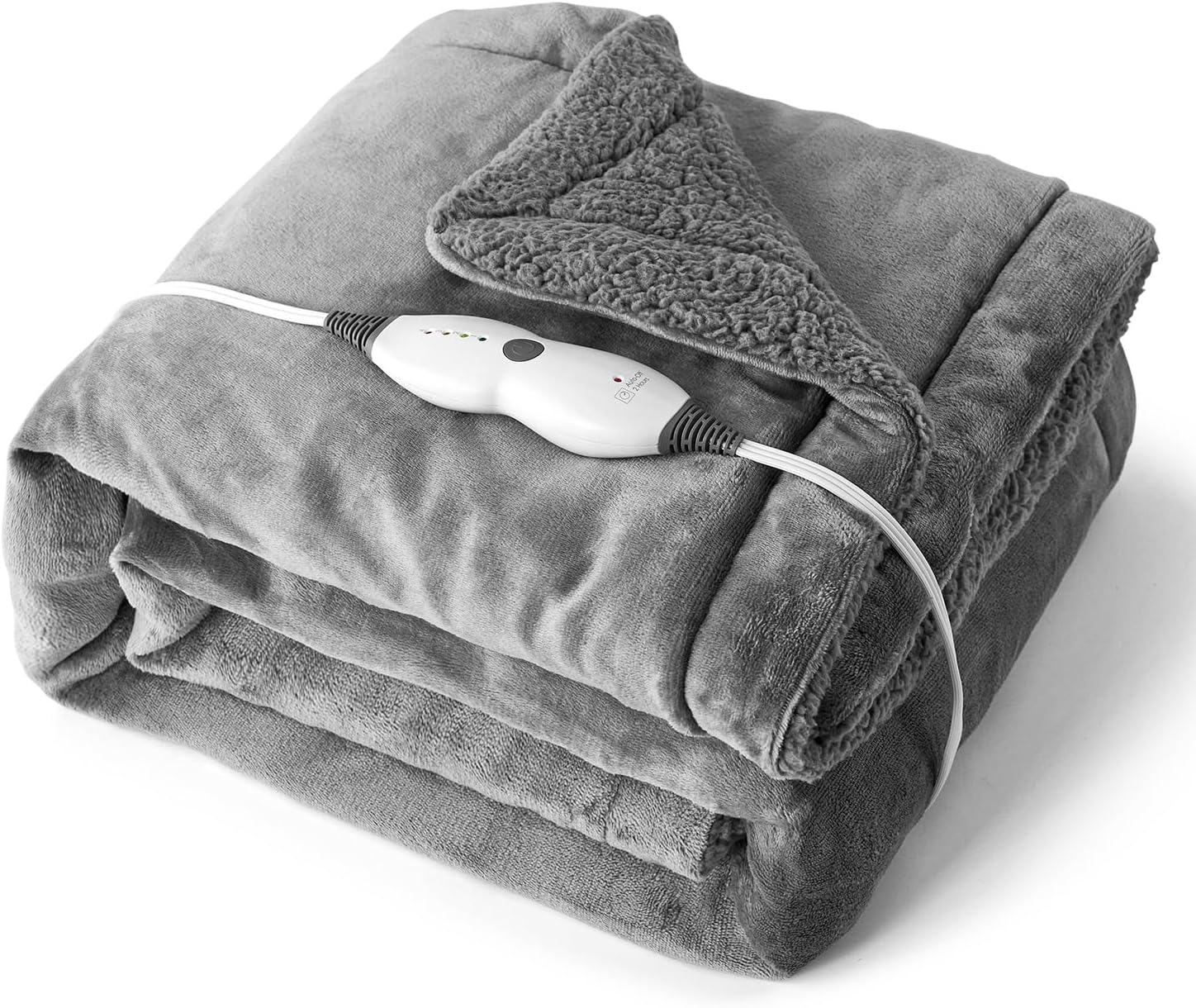
Warm-room pick: Wemore Heated Weighted Blanket for Adults, 15lbs Twin Size 48''x72'' Grey
 Visit on Amazon →
This one is two products in one: a 15-pound weighted blanket and a heated blanket, in a twin size of 48 by 72 inches, in grey. That combination solves a real problem. Weight traps heat, which is exactly why so many weighted blankets get abandoned in a warm bedroom. If you can heat the blanket and cool the room, you get the pressure without the sweat, and cool-room sleep is better sleep for most people.
What to verify before you buy, because this category has more variables than a plain weighted blanket:
Whether the weight is glass beads sewn into a quilted grid or a single heavy layer. Quilted grid, every time.
Where the controller sits and how the cord routes. A cord that crosses your chest or your neck at night is a dealbreaker, and you cannot tell from the hero photo. Read the review photos that show the blanket on a bed.
Whether there is an auto shutoff on the heat. For a blanket you sleep under, there should be.
Flaws but not dealbreakers: Heated blankets are generally not machine washable in the way a plain cotton weighted blanket is, so plan on spot cleaning and a removable top layer if you want it to last. And a cord means one more thing to unplug every morning.
Anyone who keeps their bedroom cold on purpose, or who liked the idea of a weighted blanket but hated how hot it got, should look at this one before anything else.
One hard rule from my side: a heated weighted blanket is not for anyone who cannot feel or regulate their own temperature, cannot remove the blanket without help, or is a young child. Heat plus weight plus a cord needs a person who can wake up and take it off. That is not a marketing caveat, it is the safety line I hold with clients.
Bead distribution: the shake test
This takes 60 seconds and it is the best predictor of long-term satisfaction I have found.
Hold the blanket by two adjacent corners and shake it firmly for ten seconds. Then lay it flat and feel the four quadrants with your palm.
If the corners feel thin and the center feels like a sack of potatoes, the fill is migrating. Send it back inside the return window. This is the failure mode that makes a blanket unusable, because all the weight ends up in one place on your chest.
If the whole surface feels evenly dense, with no hard lumps and no empty patches, the stitch density is doing its job.
Then run your hand along a seam and listen. Crunching is fine. A dry, rattling sound near a seam usually means beads are loose in the channel, which is where leaks start.
Do this test on day one, not week five, while you can still return it.
Washability decides whether it survives
A blanket you cannot wash is a blanket that ends up in the closet. I have watched this happen with clients who loved the weight and hated the maintenance.
What to plan for:
Check whether the blanket is machine washable, and at what temperature, before the first spill.
Use a front-loading machine if you have one, on a gentle cycle, and never a heavy agitator.
Dry on low or air dry flat. High heat cooks the stitching and can degrade any internal fill.
Count on one wash per month at most if you use a top sheet between you and the blanket. A top sheet is the cheapest way to extend the life of any weighted blanket.
If the blanket needs a duvet cover to survive a wash, that is a design flaw, not a feature. Covers shift, they wrinkle, and nobody reinstalls them at 11 p.m.
How to set it up: your first two weeks
This is the part nobody writes down, and it is the reason people quit.
Step one: try it on the couch first. Twenty minutes under it while you read. If your chest feels compressed rather than grounded, this is not your weight.
Step two: put it on top of your fitted sheet, under nothing. Not under a comforter, not over three other blankets. You want to feel the weight, not the weight plus six pounds of bedding.
Step three: give it seven to ten nights. The first two nights often feel strange. That is normal. The settling-in period is real.
Step four: adjust at the one-week mark. Too heavy, move it down to cover your legs and hips only. Too light, size up. There is no prize for tolerating the wrong weight.
Step five: shake it out weekly. Thirty seconds of shaking redistributes the fill and slows the migration that ruins blankets.
Step six: wash it at the one-month mark. Not because it is dirty, but because you want to find out how it handles a wash while the return window is still open if you can.
Step seven: set a return reminder for day 28. Every blanket I have seen abandoned was abandoned by someone who waited too long to admit it was wrong.
Who should not use one
I hold this line with clients and I will hold it here.
No weighted blankets for infants or toddlers. None. A small child cannot move a heavy blanket off their face, and that is the entire safety argument.
No blanket heavier than a child can push off alone, for any child.
No heated weighted blanket for anyone who cannot feel heat or cold normally, cannot remove the blanket unassisted, or cannot operate the controller.
If you are pregnant, talk to your doctor rather than to me. I do not make recommendations here.
If you have a respiratory condition that makes chest pressure uncomfortable, this is not the tool for you.
And the honest one: if you are looking for a treatment for a diagnosed condition, a blanket is not it. It is a sleep aid with mixed evidence. It helps some people. It is not therapy.
What this all costs
I am not going to quote prices here, because listings move and you can see the current numbers yourself. What I will tell you is where the quality lives.
The cheapest tier is where beads migrate and stitching pops. You will feel the difference by week three, and you will have spent money on a blanket you do not use.
The middle band of the market is where the real quality sits. That is where you find small-grid quilting, breathable shells, and stitching that survives a wash cycle. Both blankets above live in that band.
The boutique tier charges for branding and therapeutic language. The fabric is often no better than the middle band. I have handled both and I am not impressed by the markup.
The math that actually matters is cost per night of use. A blanket you sleep under 300 nights a year for three years is cheap at almost any price. A blanket that lives in the closet is expensive at any price, including free.
The bottom line
Do the order right and you will not be writing a return label in week four. Check the shell fabric first, because that decides whether you can stand sleeping under it in July. Do the shake test on day one, because bead distribution is what keeps the weight where it belongs. Then pick your weight from the 10% starting point and adjust without guilt.
The blanket is supposed to make sleep easier. If it is making sleep harder, it is the wrong blanket, and there is no shame in sending it back.