A kids weighted blanket is one of the few sleep purchases where the wrong choice becomes obvious within a week. The child pushes it off, or it ends up folded at the foot of the bed, or it runs too warm by the third night. The number on the label gets all the attention, but weight is only one of three variables that decide whether a blanket stays in use. The other two are size and shell fabric, and they are the ones buyers skip most often.
This guide walks through four blankets between 3 and 7 pounds, all sized for children and small sleepers, and explains how to match one to a specific bed, a specific room, and a specific child.
Related: Weighted Blanket Weight Chart: How to Find a Starting Point →
Quick answer
Match size first, then weight. A 36 by 48 inch blanket is a lap or toddler-bed size, and a 41 by 60 inch blanket covers a twin bed or a larger child. Within the correct size, choose the lightest weight the child can lift and push off without help. The often-quoted 10 percent of body weight figure is a starting point rather than a rule, and it matters less than whether the blanket actually stays on the bed. A weighted blanket is not appropriate for an infant or for anyone who cannot remove it independently.
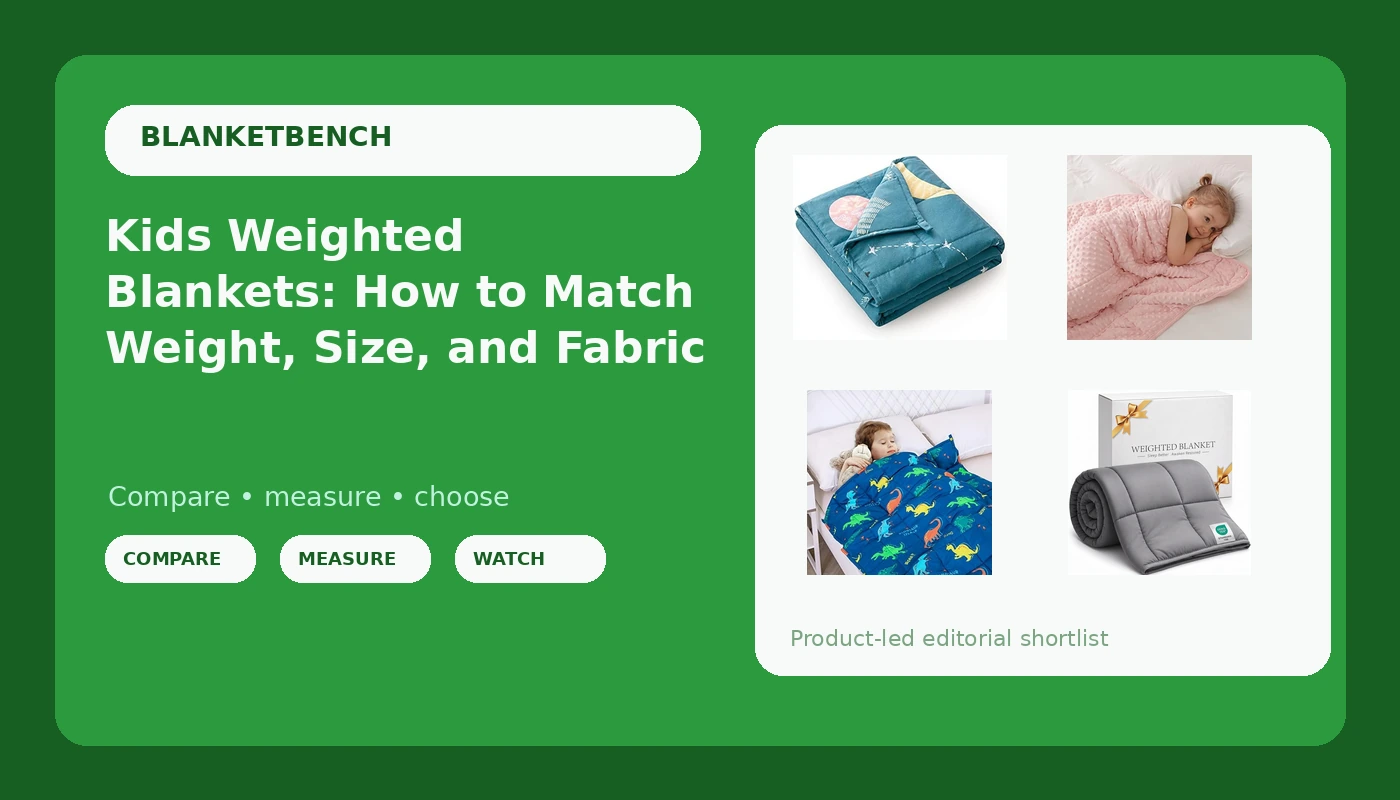
4 useful options
| Model | Best fit | What stands out |
|---|---|---|
| Smart Queen Weighted Blanket 5lbs (41 by 60 in, Grey) | Older children and adults who want a throw-size blanket | 5 pound glass-bead fill, machine washable, maker describes the shell as cooling and breathable |
| Huloo Sleep Kids Weighted Blanket Twin 7lbs (41 by 60 in, Pink) | Older children on a twin bed who want more pressure | Heaviest option here at 7 pounds, soft minky shell, premium glass beads |
| Mr. Sandman Weighted Blanket 3 Pounds (36 by 48 in, Star Moon Blue) | Younger or smaller children starting out | 3 pound fill, breathable cotton shell, nontoxic glass beads |
| Kivik Weighted Blanket 3lbs (36 by 48 in, Cooling Blue Dinosaur) | Warm bedrooms and children who run hot | 3 pound fill, shell described as cooling, 36 by 48 inch size |
The everyday throw size: Smart Queen Weighted Blanket 5lbs
The trade-off is weight. Five pounds is light for an adult who wants pressure spread across a whole body, and it is too much for a small child who would struggle to move it alone. If the blanket has to serve both a child and an adult, or will be used on a bed larger than a twin, this is the size that fits the most situations. The washable construction is not a minor detail either. A heavier blanket that can only be spot-cleaned will not survive a child's flu season, and blankets that cannot be washed are the ones that end up in a closet.
The heavier kids option: Huloo Sleep Kids Weighted Blanket Twin 7lbs
Seven pounds is where the decision gets real. On a 70 pound child, 7 pounds lands right at the top of the 10 percent guideline; on a 45 pound child, it sits well above it. Weight a child cannot push off independently is the one scenario worth avoiding outright, so test that before the blanket becomes a nightly fixture. Fabric matters here too. Minky is a plush, insulating surface compared with cotton, so in a bedroom that runs warm, or in a Chicago July, a minky shell is the kind of blanket that gets abandoned in summer. If the room stays cool, this is the most substantial of the four.
The lightest starter: Mr. Sandman Weighted Blanket 3 Pounds
Three pounds is light enough that many adults will not register meaningful pressure from it, and that is the point. This is a starter weight in a small-body size. The 36 by 48 inch dimensions mean it will not cover a twin bed, so it works as a lap blanket during quiet time, laid over a toddler bed, or folded across the legs. For a child new to weighted blankets, starting light and moving up is easier than starting heavy and backing down, because a bad first week usually ends the experiment entirely. It is also the weight to consider when a child is uneasy about being covered, since a light blanket is easy to shove aside.
The cooling pick: Kivik Weighted Blanket 3lbs
Two blankets at 3 pounds and 36 by 48 inches come down to fabric and preference rather than performance. If the child sleeps warm or the bedroom holds heat overnight, a cooling shell is worth prioritizing over a print. If the room is cool, the dinosaur is the deciding factor. At this weight and size, the blanket functions as a comfort object as much as a sleep tool, and comfort objects get used. That is not a small thing. A blanket a child actively chooses is more likely to stay on the bed than one selected purely from a weight chart.
Prices and availability may change. Product images, names, and retailer links must be matched by verified ASIN. Do not state a current price, rating, stock status, or measured result without current evidence.
Why the 10 percent guideline is a starting point, not a rule
The 10 percent figure is a convention, not a clinical standard. It circulates because it gives anxious buyers a number to grab, and a number feels safer than a judgment call. In practice, weight tolerance varies enormously from person to person, and body weight is only a rough proxy for how much pressure feels calming.
The mechanism most often cited is proprioceptive input: deep, even pressure on the body that some people find regulating. Occupational therapists use weighted products with sensory-processing clients for exactly this reason, and the response is individual. Some people feel settled under a heavy blanket within minutes. Others feel trapped. The same 7 pound blanket can produce opposite reactions in two children of identical size.
That variability is why starting light and adjusting upward works better than starting at the guideline and adjusting down. A blanket that feels too light is disappointing. A blanket that feels too heavy is rejected, and rejection is harder to undo because the association sticks.
It is also worth being honest about the evidence. Research on weighted blankets for sleep and anxiety is mixed, sample sizes are small, and placebo effects are plausible and difficult to separate from the pressure itself. A weighted blanket is a sleep aid that works for some people, not a treatment. It does not treat ADHD or autism, and it should not replace anything a clinician has recommended.
Fabric and bead distribution: what actually decides whether a blanket gets used
Weight gets the marketing attention, but fabric and construction decide the outcome.
Shell fabric governs breathability. Cotton and bamboo shells move heat and moisture away from the body. Polyester shells, and plush fabrics like minky, hold warmth. In a cool bedroom that is pleasant; in a warm one it is the reason a blanket gets kicked off by 2 a.m. If you are choosing between two blankets at the same weight, pick the shell that matches the room, not the print.
Bead distribution governs whether the blanket feels like a blanket. Glass beads are sewn into small compartments, and the size and stitching of those compartments determine whether the fill stays where it is supposed to. A well-made blanket holds its weight evenly across the surface. A poorly made one pools its fill in the center or drifts toward the edges, and what you feel is a heavy lump rather than even pressure. When you inspect a blanket, look at the seam grid: smaller, more numerous compartments with dense stitching hold beads in place better than large open channels.
Washability governs longevity. Children spill things, get sick, and drag blankets across floors. A blanket that requires a duvet cover to survive cleaning adds a step that most families abandon within a month. A machine-washable blanket gets washed, and a blanket that gets washed stays in rotation.
One more practical point on construction: check the corners and the binding. Corners are where stitching fails first, and a popped seam at a corner means migrating beads and a blanket that has to be replaced.
- Measure the bed or the body the blanket is for. A 36 by 48 inch blanket is a lap or toddler size; a 41 by 60 inch blanket fits a twin bed or an older child.
- Start at the low end of the plausible weight range rather than the middle. Moving up after a week is easy; moving down after a rejection is not.
- Confirm the child can lift, push off, and get out from under the blanket without help. If they cannot, the blanket is too heavy for them regardless of what any chart says.
- Read the care instructions before you buy. Machine washable beats every other feature if the alternative is a blanket that never gets cleaned.
- Change one variable at a time. If you switch weight and fabric in the same week, you will not know which one caused the result.
Practical guidance for buying a kids weighted blanket
- Match the blanket to the bed it will live on. A twin bed needs roughly a 41 by 60 inch blanket; a 36 by 48 inch blanket will not cover it.
- Choose the cooler shell in warm bedrooms. Cotton and shells described as cooling are the safer pick from late spring through early fall.
- Prefer a machine-washable blanket over a premium fabric that needs a cover. Care instructions predict use more accurately than thread count does.
- Avoid any blanket a child cannot remove alone, and skip weighted blankets entirely for infants.
- Give it a two-week trial before deciding. A first night that feels strange is not a verdict, and a first week that ends with the blanket on the floor usually is.
Which option should you choose?
Choose the Smart Queen Weighted Blanket 5lbs when you want one throw-size blanket that works for an older child or an adult, and you want it machine washable. Choose the Huloo Sleep Kids Weighted Blanket Twin 7lbs when an older child on a twin bed wants noticeably more pressure and the bedroom stays cool. Choose the Mr. Sandman Weighted Blanket 3 Pounds when a younger or smaller child is trying a weighted blanket for the first time and cotton breathability matters. Choose the Kivik Weighted Blanket 3lbs when the room runs warm, the child sleeps hot, and the same 3 pound, 36 by 48 inch format is the right fit.
The caveat that applies to all four: the evidence for weighted blankets is mixed, individual responses vary, and none of these is a treatment for a diagnosed condition. Buy one expecting a sleep aid that may help and may not, and keep the return window in mind while you find out.
The bottom line
Size first, weight second, fabric third. Get the dimensions right for the bed, pick the lightest weight the child can move independently, and choose the shell that matches the temperature of the room. Those three decisions predict whether a kids weighted blanket stays on the bed far better than any percentage guideline. The four blankets here cover the useful range for children and small sleepers, from a 3 pound cotton starter to a 7 pound twin-size option, and each one is a reasonable answer to a slightly different question.