A weighted blanket only earns its place on the bed if you keep using it, and the two specs that decide that are size and weight. Search for weighted blanket sizes and weights and you get a wall of numbers: 7 pounds, 20 pounds, 30 pounds, and footprints running from a 41 by 60 inch throw up to an 80 by 87 inch king. The trouble is that those numbers get presented as a prescription when they are closer to a range. Buy too heavy and you spend the night wrestling the thing off your chest. Buy the wrong footprint and two sleepers fight over the edges until one of them gives up and moves to the couch. Buy a shell that traps heat and the blanket migrates to the foot of the bed by week two, which is exactly where most abandoned weighted blankets end up.
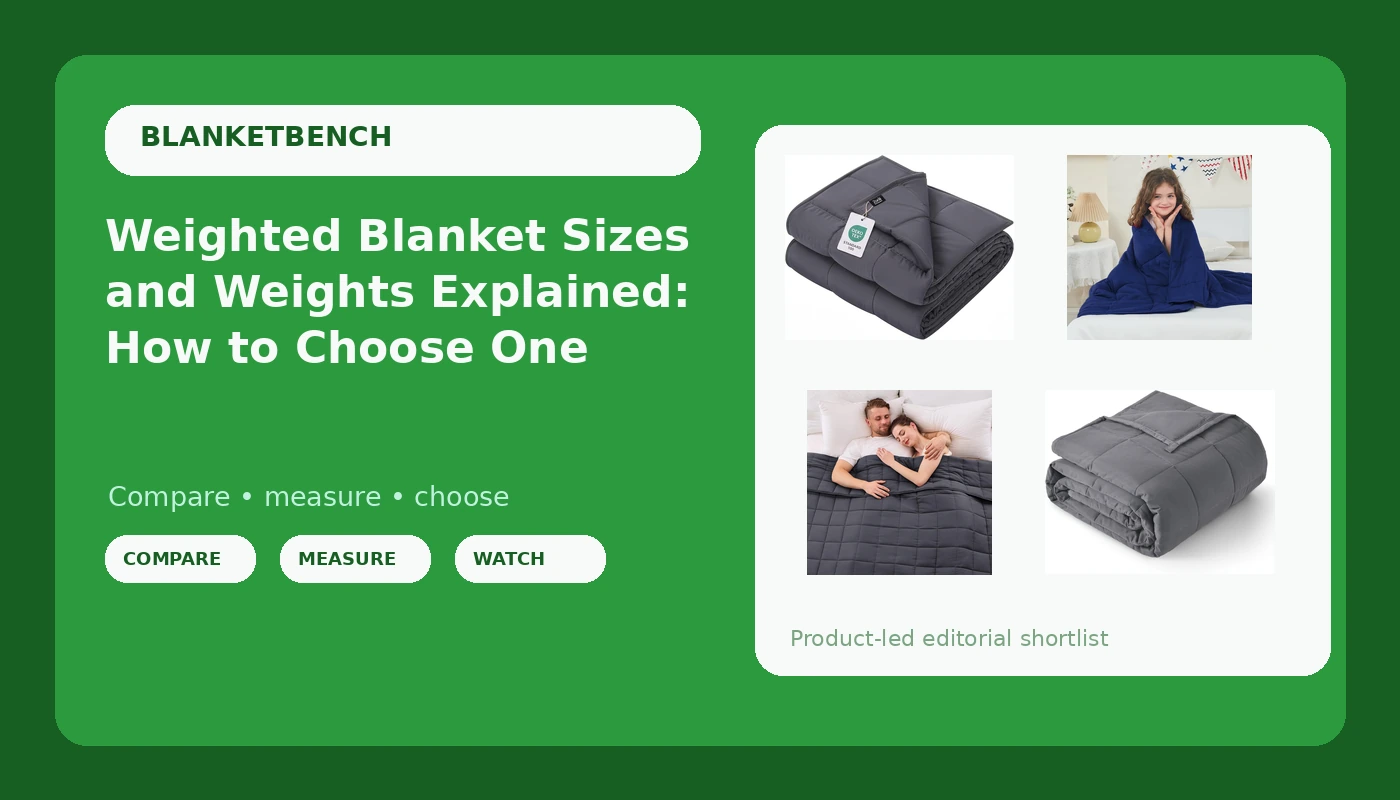
This explainer covers how weight, dimensions, and fabric interact, then applies that framework to four specific blankets at different points on the spectrum, from a 7 pound throw to a 30 pound king.
Related: Weighted Blanket Weight Chart: What 10, 15, and 20 Pounds Actually Feel Like →
Quick answer
Match the blanket's footprint to your mattress first, then start near 10 percent of your body weight and treat that number as a starting range rather than a rule. A throw-sized blanket around 41 by 60 inches suits a couch or a lap. A 60 by 80 inch blanket covers a full or queen bed for one sleeper. An 80 by 87 inch blanket is a king footprint built for two. If you sleep hot, filter by shell fabric and cooling construction before you filter by weight. No single weight is right for everyone, the evidence on weighted blankets as a sleep intervention is mixed, so treat the first purchase as a test you can return.
4 useful options
| Model | Best fit | What stands out |
|---|---|---|
| ZonLi Weighted Blanket for Adults (60"x80", 20lbs, Dark Grey) | One adult on a full or queen bed | A 60 by 80 inch footprint at 20 pounds, the middle of the range most adults start in |
| yescool Weighted Throw Blanket 7lbs, 41" x 60", Blue | Couch, lap, and nap use | A small 41 by 60 inch throw format at 7 pounds, the lightest and most portable option here |
| yescool King Size Weighted Blanket for Adults (30 lbs, 80" x 87", Grey) | Couples on a king bed | An 80 by 87 inch king footprint at 30 pounds, positioned by the maker for sleepers around 290 to 310 pounds |
| Topblan Cooling Weighted Blanket for Adults, 20 lbs 60 x 80 Queen Size Bed | Hot sleepers on a queen bed | A 20 pound, 60 by 80 inch queen-size blanket with cooling construction as its headline feature |
Best for solo adult sleepers: ZonLi Weighted Blanket for Adults (60"x80", 20lbs, Dark Grey)
The trade-off here is concentration. Twenty pounds spread across 60 by 80 inches is a moderate load over a large area, which is what makes it comfortable for a single adult. Put two people under it and that same weight becomes a nightly negotiation, because there is no spare width and the blanket is not built to be shared. If your bed has two sleepers, this is the wrong shape regardless of how the weight feels to you alone.
Best for couch and nap use: yescool Weighted Throw Blanket 7lbs, 41" x 60", Blue
The case for starting here is honest and practical: if you are not sure whether deep pressure helps you settle, a throw is the lowest-commitment way to find out. It is also the only option on this list you can carry from room to room without thinking about it. The limit is coverage. A throw will not drape a queen bed, and if you move around at night it will end up on the floor.
Best for couples on a king bed: yescool King Size Weighted Blanket for Adults (30 lbs, 80" x 87", Grey)
Two trade-offs come with this one. First, 30 pounds is genuinely heavy to move, which matters at 2 a.m. and matters more if anyone in the house has limited strength. Second, machine washable does not mean easy to wash: a king-size weighted blanket is a bulky load, and you should confirm your washer's drum capacity and the maker's care instructions before you buy. A blanket that is too heavy for your machine is a blanket that becomes a dry-cleaning problem.
Best for hot sleepers on a queen bed: Topblan Cooling Weighted Blanket for Adults, 20 lbs 60 x 80 Queen Size Bed
The trade-off is that cooling is a design intent, not a measured outcome. Two blankets can claim it and perform differently depending on the shell weave and how tightly the fill is packed. What you can compare honestly is the spec sheet: same weight, same footprint, different construction priorities. If heat is your reason for hesitating on weighted blankets in the first place, that difference is the one worth paying attention to.
Prices and availability may change. Product images, names, and retailer links must be matched by verified ASIN. Do not state a current price, rating, stock status, or measured result without current evidence.
How the 10 percent guideline works, and where it stops being useful
The 10 percent guideline says to start with a blanket weighing roughly a tenth of your body weight. A 150 pound sleeper lands at 15 pounds, a 200 pound sleeper at 20. It scales with the person, which is why it survives as a rule of thumb, and it loosely tracks the mechanism most often cited for weighted blankets: deep pressure that provides proprioceptive input, the same kind of feedback your body uses to locate itself in space. That input is about how load is distributed across the body, not about hitting an exact number of pounds.
Where the guideline stops being useful is the moment it gets treated as a prescription. The usable range around it is wide. Many adults settle comfortably between 8 and 12 percent of body weight, and some prefer more. Tolerance also shifts with the size of the blanket. Twenty pounds spread across 60 by 80 inches feels different from 20 pounds concentrated on a 41 by 60 throw, because the smaller blanket applies the same style of load to a smaller area. That is why a 7 pound throw can feel heavier on your lap than a 20 pound blanket feels across your legs, and why copying someone else's weight rarely works.
There is a practical ceiling too. A blanket heavy enough to be hard to lift, reposition, or push off in the night creates a new problem while solving an old one. Heavier is not automatically more effective, and it is certainly not more comfortable. This is also why weight recommendations for children and infants are a separate conversation entirely, and one I stay out of.
Shell fabric, bead distribution, and stitch density
Two blankets with identical weights and dimensions can behave like different products, because the shell and the fill decide how that weight behaves in use.
Shell fabric governs breathability. Cotton and bamboo shells move heat and moisture; a tightly woven synthetic shell can turn a warm sleeper's bed into a sauna. In a city with real summers, the fabric is often the difference between a blanket that stays on the bed in July and one that lives in the closet until October. Cooling construction, which appears in the names of two blankets above, is a maker's claim about how the shell and fill shed heat. Treat it as design intent worth comparing, not as a guarantee.
Bead distribution governs comfort. Glass or plastic beads are sewn into compartments, and the compartment stitching is what stops the fill from sliding into a pile in the middle or along the edges. Blankets with wide, unquilted channels let beads migrate; blankets with a dense grid keep the load where it started. If you have used a weighted blanket that felt like a sack of potatoes parked on your sternum, that was a bead distribution problem, not a weight problem.
Stitch density and seam quality decide how long the blanket lasts. Weighted blankets fail at the seams, where the fill presses hardest. Closely spaced, reinforced stitching holds; sparse stitching at the corners develops leaks. Washability follows from the same construction. A blanket you can machine wash without the fill clumping stays in rotation. One that needs a duvet cover to survive a wash cycle is a blanket that ends up folded on a shelf.
- Measure the mattress before you look at weight. A 41 by 60 inch throw is a couch blanket, a 60 by 80 inch blanket covers a full or queen bed for one sleeper, and an 80 by 87 inch blanket is a king footprint for two.
- Convert your body weight into a starting range. Take 10 percent, treat 8 to 12 percent as your test zone, and plan to adjust after a week of real sleep rather than a night of curiosity.
- Decide how many sleepers the blanket serves. Two people under one heavy blanket generally want the larger footprint. Two people who run at different temperatures usually want two separate blankets.
- Filter by shell fabric and cooling construction if you sleep warm. Breathability decides summer use more than weight does.
- Check the care instructions and your washing machine's capacity before you commit, especially on a king-size blanket.
What to check before you buy
- Match the blanket to the mattress, not the other way around. Footprint is the spec you cannot adjust later.
- Weigh the laundry problem honestly. A king-size 30 pound blanket is machine washable in name, but confirm your drum capacity and the maker's care instructions first.
- If you sleep hot, make breathability your first filter. Cooling shells and cotton or bamboo fabrics matter more to summer use than the number of pounds.
- Use a throw as a low-commitment test. A 7 pound, 41 by 60 inch blanket tells you whether deep pressure helps you settle before you spend on a bed-size version.
- Buy somewhere with a real return window. Weight preference is personal, and the only reliable test is sleeping under the blanket for several nights.
Which option should you choose?
Choose the ZonLi Weighted Blanket for Adults (60"x80", 20lbs, Dark Grey) when you sleep alone on a full or queen bed and want a standard 20 pound adult blanket in the middle of the weight range. Choose the yescool Weighted Throw Blanket 7lbs, 41" x 60", Blue when you want a lap or couch blanket, or you want to test whether weighted pressure helps you before committing to bed-size dimensions. Choose the yescool King Size Weighted Blanket for Adults (30 lbs, 80" x 87", Grey) when two people share a king bed, you specifically want a heavy 30 pound fill, and you have the laundry setup for a blanket that size. Choose the Topblan Cooling Weighted Blanket for Adults, 20 lbs 60 x 80 Queen Size Bed when you sleep warm and want a 20 pound queen-size blanket with cooling construction as its main selling point.
None of this is a treatment plan. The research on weighted blankets is mixed, the placebo effect is real, and a blanket is a sleep aid rather than a therapy. Weight tolerance is personal and best discovered by sleeping under something you can send back. Nothing here applies to infants or young children, and if you are pregnant or managing a condition that affects breathing or circulation, talk to a clinician before adding weight to your bed.
The bottom line
Weight and size are the two decisions you cannot fix later, so make them first and make them for your actual body and your actual mattress. Start near 10 percent of your body weight, treat that as a range rather than a rule, and size the blanket to the bed it will live on: a throw for laps and couches, 60 by 80 inches for one sleeper on a full or queen, and a king footprint only when two people are genuinely sharing it. Then let fabric make the final call. A blanket with the right weight and a shell that traps heat is a blanket you will stop using, and the abandonment rate is the only metric that really matters.