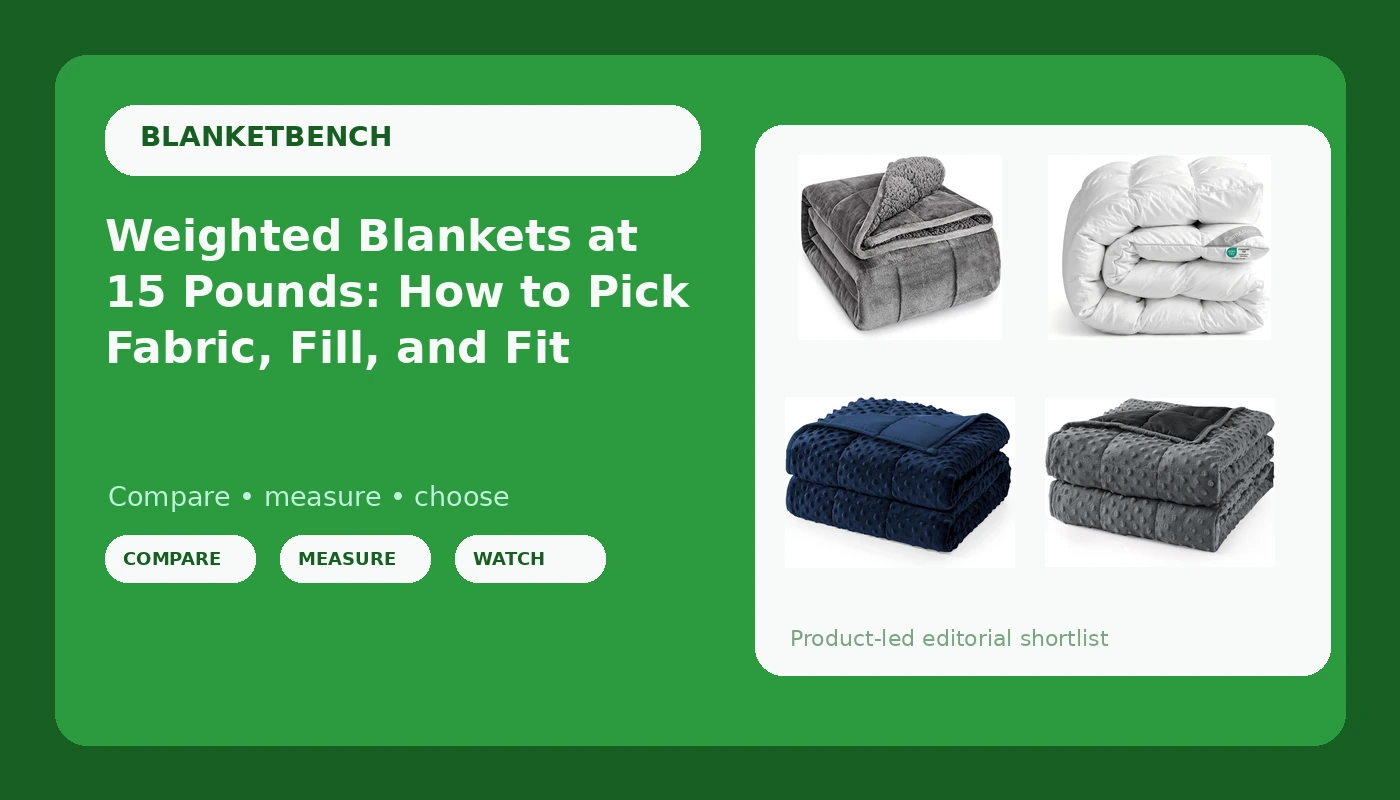
A 15 lb weighted blanket sits in the middle of the category: heavy enough that most adults feel clear pressure within a minute of getting under it, light enough that you can still roll over without a fight. That middle position is exactly why it is so easy to buy the wrong one. The blanket arrives, feels wonderful for four nights, and then migrates to the foot of the bed or the top shelf of the closet, and the reason is almost never the weight.
I am Priya, an occupational therapist in Chicago. I work with anxiety and sensory-processing clients, and I have watched enough of them either keep a blanket for years or abandon it inside a month to have opinions about what separates the two groups. It is usually fabric and bead distribution, not fill weight. A shell that traps heat loses to a Chicago July. Beads that slide to the corners leave you with a heavy lump near your feet and nothing on your chest.
This explainer covers four 15 lb weighted blanket options that are currently sold, what each one is built for, and how to work out whether 15 pounds is even your number. The evidence on weighted blankets is mixed, and I will say that plainly: they help some people settle faster and feel calmer, they do nothing for plenty of others, and they are not a treatment for any diagnosis.
Related: Weighted Blanket Weight Chart: What 10% Really Means →
Quick answer
A 15 lb weighted blanket is a reasonable starting point if you weigh roughly 130 to 170 pounds and sleep alone or mostly alone, which is the band where 15 pounds usually lands near the 10% guideline without feeling like a sandbag. If you weigh well under 130 pounds, size down. If you share a bed, buy a size that covers you rather than the mattress, or expect a nightly tug of war. All four options below are 15 lb blankets in different shells and sizes: a twin sherpa fleece, a hybrid duvet, and two queen blankets, one of which states a 60 x 80 inch footprint. None of them is a medical device, and none is "the best" for everyone.
4 useful options
| Model | Best fit | What stands out |
|---|---|---|
| Wemore Weighted Blanket for Adults 48"x72" 15 lbs Twin, Sherpa Fleece Grey | Solo sleepers who want a smaller footprint and a textured, warm-leaning face fabric | Twin 48 x 72 inch size, 15 lb fill, sherpa fleece face in grey |
| Calm&Relax Hybrid Weighted Blanket - Fluffy Cloud-Like Duvet & Gravity | Sleepers who want a duvet look and a plush top layer instead of a flat quilted shell | Hybrid build described by the maker as a cloud-like duvet paired with gravity-style weight |
| Cottonblue Weighted Blanket 15lb Queen Size for Adults Better Sleep & Relax | Queen-bed sleepers who want a conventional 15 lb blanket at a queen size | Queen size, 15 lb fill, positioned by the maker around adult sleep and relaxation |
| Mr. Sandman Weighted Blanket for Adults, Queen Size 15 lbs, 60 x 80 Inches | Shoppers who want an explicitly stated queen footprint before they buy | 15 lb fill and a stated 60 x 80 inch queen size |
Twin size, 15 lb: Wemore Weighted Blanket for Adults 48"x72" 15 lbs Twin, Sherpa Fleece Grey
Fleece is the trade-off to think about first. A sherpa face holds warmth and feels cozy from October through April, and that same quality is why some people stop using it in July. If your bedroom runs hot, or you sleep warm year round, a fleece-faced blanket is the one most likely to end up pushed to the side of the bed by the second week. If your room is cool and you like the idea of a blanket that feels like a heavy throw, this is the shape and texture that suits that job. The 48 x 72 inch size covers one adult torso and legs, not a mattress, so it works best for a solo sleeper who does not want to share. Check the listing for care instructions before you commit, since fleece finishes vary in how they handle machine washing.
Hybrid duvet build: Calm&Relax Hybrid Weighted Blanket - Fluffy Cloud-Like Duvet & Gravity
Duvet styling solves one problem and creates another. On the plus side, a blanket that looks like bedding is a blanket you are less likely to feel silly about leaving out, and appearance turns out to matter for how long people actually keep using one. On the minus side, a fluffy top layer traps air, and trapped air is insulation. If you have ever slept under a down duvet in a warm room, you know the result. The practical question is whether the duvet layer is removable and washable, because a plush cover that cannot be cleaned is the single most common reason a good blanket gets retired. Read the care section of the listing carefully, and if the cover is not removable, plan on a top sheet or a duvet cover between you and the blanket.
Queen size, 15 lb: Cottonblue Weighted Blanket 15lb Queen Size for Adults Better Sleep & Relax
The thing to understand about a queen-size weighted blanket is that "queen" describes the top surface, not the drape. A queen blanket laid on a queen mattress covers the sleeping surface and stops there. It does not hang over the sides the way a comforter does, and it will not stay put if a partner rolls. That is fine for one sleeper who wants coverage from shoulders to feet and does not need overhang. It is frustrating for two people. If you are buying for a shared bed, treat the blanket as a personal item and expect to buy two, or accept that you will both be tugging at the same 15 pounds. Also check the shell fabric description on the listing, since two blankets at the same weight and size can sleep very differently depending on what the outer layer is made of.
Queen, 60 x 80 inches: Mr. Sandman Weighted Blanket for Adults, Queen Size 15 lbs, 60 x 80 Inches
Sixty by eighty inches is the standard queen mattress measurement, so this blanket covers the top of a queen bed edge to edge with no overhang. That is exactly what you want if you sleep alone and want your shoulders and feet inside the blanket at the same time. It is also the reason a taller sleeper should measure rather than assume: at 80 inches long, a very tall person will still find their feet near the edge. Compare this against the other queen option on shell fabric and stitching pattern, because at the same size and the same 15 lb fill, fabric and quilt construction are the only things left to differentiate them. Both are worth checking on care instructions before you buy.
Prices and availability may change. Product images, names, and retailer links must be matched by verified ASIN. Do not state a current price, rating, stock status, or measured result without current evidence.
Why the 10% guideline is a starting point, not a rule
The familiar advice is to buy a blanket that weighs about 10% of your body weight. That number circulates as if it came from a clinical standard. It did not. It is a rough starting heuristic that became a marketing convention, and it falls apart at both ends of the weight range. A 200 pound sleeper following it would buy a 20 pound blanket, which many people find oppressive rather than soothing. A 110 pound sleeper would buy 11 pounds, which is a weight many makers do not even offer.
The mechanism people point to is proprioceptive input: deep, even pressure on the body that some nervous systems read as calming, similar in principle to a firm hug or a weighted lap pad. That mechanism is plausible and the research on it is genuinely mixed, with small studies and inconsistent results. What that means practically is simple. Weight is a dial you adjust, not a prescription you fill. Start near 10% if you want a reference point, then move down if you feel pinned or move up if the blanket feels like a sheet. Fifteen pounds is a common middle setting because it suits a wide band of adults, not because it is correct.
Fabric and bead distribution decide whether you keep using it
Two blankets can weigh the same 15 pounds and behave nothing alike. The first difference is the shell. Cotton, bamboo, and other breathable weaves move heat and moisture away from your body. Tight synthetic shells do the opposite, and a blanket that makes you sweat is a blanket you stop using, regardless of how good the pressure feels. In a climate with real summers, fabric is the deciding variable.
The second difference is where the weight sits. Good weighted blankets are quilted into a grid of small pockets, so the fill stays spread across the surface. Poorly built ones let the fill migrate, and after a month you have a blanket that is heavy at the edges and empty in the middle, which is the opposite of the even pressure you bought it for. Look at how the blanket is sectioned, how dense the stitching looks, and whether the compartments are small enough to hold fill in place. Bead type matters too: glass fill is denser, so it takes less volume to reach a given weight, while plastic fill needs more room. Neither is automatically better, but denser fill in a well-sewn grid tends to distribute more evenly.
- Weigh yourself and set a starting target near 10%, then plan to adjust in either direction.
- Measure your bed and decide whether you want a blanket that covers the top surface or one that drapes over the sides.
- Read the shell fabric description and pick a breathable weave if your bedroom runs warm.
- Look at the quilting pattern and the care instructions, since both predict how long the blanket stays in rotation.
- Buy from a seller with a return policy you can live with, and give the blanket a genuine two-week trial before deciding.
What to check before you buy
- Confirm the blanket's stated dimensions against your own measurements, not against the size label alone.
- Read the washing instructions before purchase. A blanket you cannot clean is a blanket you will not keep.
- Check whether the fill is described as glass or plastic, and how the blanket is compartmentalized.
- Plan for a top sheet or removable cover if the shell fabric or duvet layer is not easy to launder.
- Keep the weight honest. If a blanket feels like too much after a week, size down rather than toughing it out.
Which option should you choose?
Choose the Wemore Weighted Blanket for Adults 48"x72" 15 lbs Twin, Sherpa Fleece Grey when you sleep alone, want a personal-size blanket rather than a bed cover, and prefer a warm fleece texture in a cool bedroom. Choose the Calm&Relax Hybrid Weighted Blanket - Fluffy Cloud-Like Duvet & Gravity when you want your blanket to look like bedding and you are willing to check whether the duvet layer can be washed. Choose the Cottonblue Weighted Blanket 15lb Queen Size for Adults Better Sleep & Relax when you want a conventional queen-size 15 lb blanket and are comparing shells and construction. Choose the Mr. Sandman Weighted Blanket for Adults, Queen Size 15 lbs, 60 x 80 Inches when an explicitly stated 60 x 80 inch footprint is the detail you care about most.
One caveat worth repeating: weighted blankets are a comfort product with mixed evidence behind them, not a treatment. If you are pregnant, buying for a young child, or managing a condition where chest pressure is a concern, talk to a clinician first rather than shopping on a percentage rule.
The bottom line
A 15 lb weighted blanket works when the weight suits your body, the size suits your bed, and the fabric suits your bedroom's temperature. Get the fabric wrong and the blanket leaves the bed within a month no matter how good the pressure feels. Get the size wrong and you will fight it every night. Start with the 10% guideline as a reference, then adjust, and treat shell material and quilting as the two details that decide whether the blanket becomes a habit or a closet resident. The four options here all sit in the same weight class, and they differ mostly in footprint and construction style, which is exactly where your decision should focus.