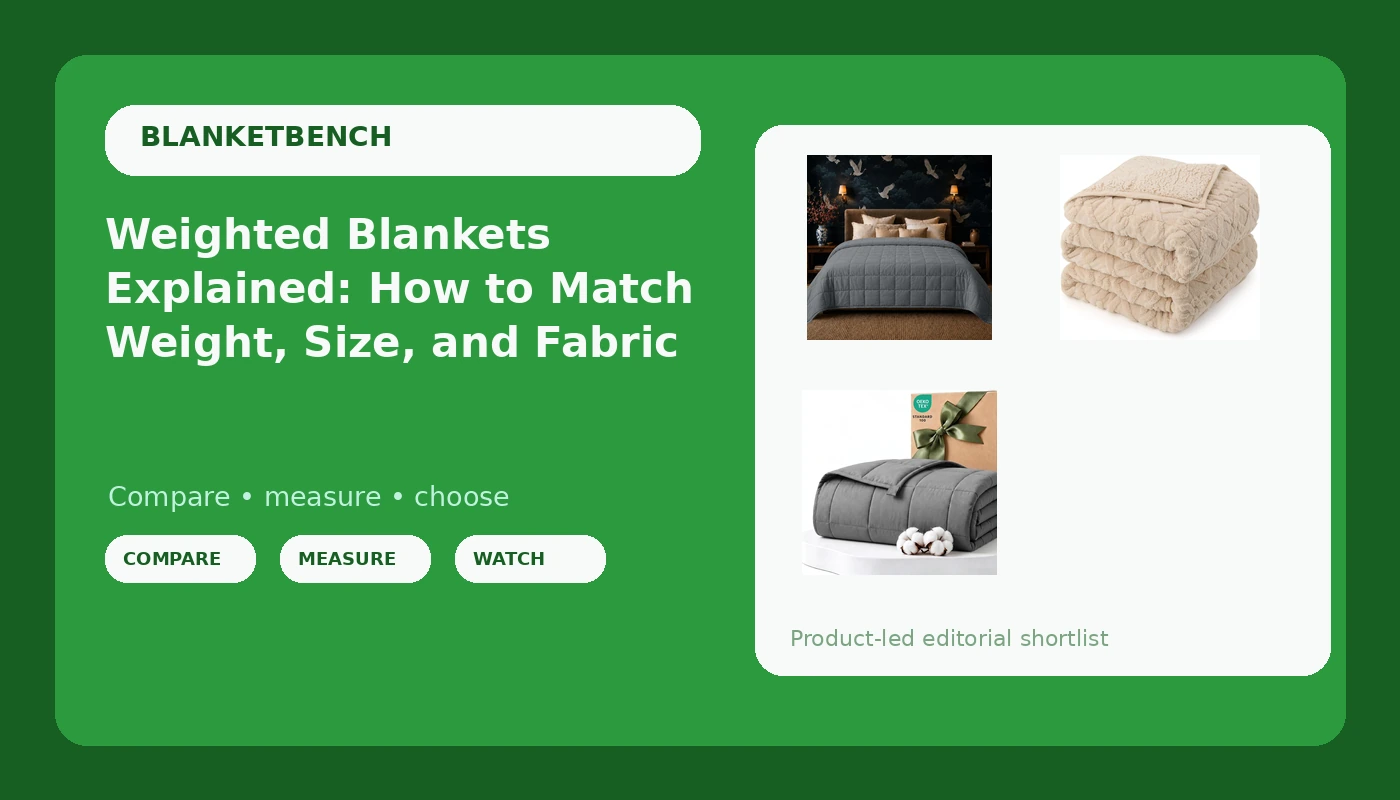
A weighted blanket is one of the few sleep products where the spec sheet matters less than how the thing behaves on your body at two in the morning. The weight has to stay where it is placed, the shell has to let heat escape, and the blanket has to survive a washing machine. A useful weighted blanket weight guide starts with the 10% guideline and then immediately complicates it, because the number on the label is only the first of three decisions. The 10% guideline suggests starting near one tenth of your body weight, which lands around 15 pounds for a 150 pound sleeper and 18 to 20 pounds for someone closer to 200. In practice, weight is a range, not a prescription. Plenty of adults settle happily below that number, and plenty of people who buy the heaviest blanket they can find stop using it within a month because the shell traps heat or the beads migrate toward the edges. This explainer walks through how weight, size, and fabric interact, using three very different blankets as illustrations.
Related: How to Wash a Weighted Blanket Without Ruining the Beads →
Quick answer
Start near 10% of your body weight, then adjust down if you sleep hot or up if the blanket feels insubstantial, and treat 15 pounds as the middle of the road for most adults. Size matters as much as weight: a twin or throw suits a single sleeper, while a queen or king size blanket is for a shared bed or someone who wants full coverage. A 50 pound blanket sits far outside the 10% guideline for nearly every adult and is a specialist purchase for a sleeper who already knows they want maximum weight and can move it without assistance. Fabric, bead distribution, and washability usually decide whether the blanket stays on the bed past week two, so read those details before you look at the weight number.
3 useful options
| Model | Best fit | What stands out |
|---|---|---|
| Gkyet Weighted Blanket for Adults (48" x 72" 15 lbs, Twin Size) Grey Soft Cooling Weighted Blanket with Glass Beads | A single adult sleeper who wants a lighter, washable blanket | Twin 48 by 72 inch dimensions, 15 pound fill, glass beads, described as breathable and machine washable |
| HomeSmart King Size Weighted Blanket 50 lbs | A sleeper who already knows they want the heaviest option available | King size coverage with a 50 pound fill, which the brand positions as the heaviest weighted blanket |
| Drewin Weighted Blanket Queen Size 15lbs for Adults, Beige, 60 x 80 inches | A queen bed, a couple, or anyone who wants full width at a moderate weight | Queen 60 by 80 inch dimensions, 15 pound fill, beige colorway |
The everyday starting point: Gkyet Weighted Blanket for Adults (48" x 72" 15 lbs, Twin Size)
This is the shape most adults should look at first, and the reasoning is not complicated. Fifteen pounds is close to the 10% mark for a 150 pound sleeper, it is light enough to pull off in the middle of the night without a struggle, and it is heavy enough to feel like something is there. The 48 by 72 inch footprint is a single-sleeper size, so it works draped over one person or laid across the lower half of a larger bed. The trade-offs are equally clear. If you weigh closer to 200 pounds, 15 pounds will read as light, and the 10% guideline would put you nearer 20. A twin blanket also will not cover two adults, and the brand's cooling language is a description of the shell rather than a guarantee that you will sleep cold. If you run hot, the honest test is whether the fabric feels breathable in your hand and whether the listing describes the shell material in plain terms instead of leaning entirely on the word cooling.
The maximum weight option: HomeSmart King Size Weighted Blanket 50 lbs
Fifty pounds is a different category of object. For it to sit near the 10% guideline, a sleeper would need to weigh around 500 pounds, which tells you this blanket is not being chosen by the usual math. It is chosen by someone who has already used a 20 or 25 pound blanket, liked the pressure, and wants more of it, or by someone shopping purely for the heaviest available option. Before you go there, run through the practical questions honestly. Can you lift the blanket with one hand and move it off your chest while lying down? Can you get it into a machine, or will it need a commercial laundry or a duvet cover you wash instead? If you share a bed, a 50 pound king size blanket is a shared decision, because your partner will be lifting it too. For most people the ceiling of comfort arrives well before 50 pounds, and a blanket you cannot move on your own is a blanket that ends up folded at the foot of the bed.
The queen size option: Drewin Weighted Blanket Queen Size 15lbs for Adults, Beige, 60 x 80 inches
Here is the interesting comparison: this blanket and the Gkyet blanket carry the same 15 pound fill, but the Drewin spreads that weight across a queen footprint instead of a twin one. More surface area at the same total weight means less pressure per square inch, so the sensory effect is gentler and more spread out. Some sleepers prefer that, describing it as a settled feeling rather than a hug. Others find that a wider blanket at the same weight simply feels thinner. The size is the selling point: 60 by 80 inches covers a queen mattress properly, and it is a realistic option if you want one blanket across a bed rather than a twin draped over your half. Two caveats worth weighing. A lighter fill on a wider blanket can feel insubstantial to someone who wants pronounced pressure, and the beige shell is a color that shows body oils and spills sooner than a dark grey or navy. Check the care instructions carefully before you commit, because a queen size blanket is harder to wash than a throw.
Prices and availability may change. Product images, names, and retailer links must be matched by verified ASIN. Do not state a current price, rating, stock status, or measured result without current evidence.
Why the 10% guideline is a starting point, not a rule
The 10% guideline exists because it gives a shopper a sane place to begin, and it has survived because the underlying idea is reasonable: deep pressure input, the steady firm contact of weight distributed across the body, is what many people find calming. That is the concept of proprioceptive input, and it is the same reason a heavy duvet or a tightly tucked sheet feels settling to some sleepers. What the guideline is not is a formula with an outcome attached. Body weight, sleep position, temperature regulation, and personal preference all push the right number up or down.
The evidence here is genuinely mixed. Weighted blankets have been studied as sleep aids, and results vary by population, by study design, and by how the outcome was measured. Some people report falling asleep faster and waking less; others notice nothing at all. The placebo effect is real and probably contributes to part of the benefit people describe, which does not make the benefit unreal, but it does mean you should treat a weighted blanket as an aid you experiment with rather than a treatment that either works or fails. I work with anxious sleepers, and the honest summary I give them is that a weighted blanket is worth a try if they like the sensation, and not worth forcing if they do not.
The practical version of the guideline looks like this. Take 10% of your body weight, then move one step down if you sleep hot, sleep on your stomach, or feel trapped by heavy bedding. Move one step up if the lighter option felt like nothing. Most adults end up between 12 and 20 pounds, which is why 15 pounds is the most common adult size on the market. Heavier is not more therapeutic, it is just heavier, and it brings real downsides: heat retention, difficulty repositioning, and the risk that you cannot remove the blanket quickly if you want to. A weighted blanket is not appropriate for infants or young children, and it is not something to use during pregnancy without checking with a clinician first.
How shell fabric and bead distribution decide whether you keep it
Weight gets all the attention, but the abandonment stories I hear rarely start with weight. They start with sweat, with beads that have drifted into the corners, or with a blanket that cannot be washed. If you take one thing from this guide, take this: fabric is the product.
Shell fabric controls breathability. Cotton and bamboo shells move moisture and heat away from the body reasonably well. Dense synthetic shells can behave like a sauna, especially under a comforter in a Chicago summer with the air conditioning off. If you sleep hot, the shell material deserves more of your attention than the fill weight, because a breathable 20 pound blanket you use every night beats an airtight 15 pound blanket you abandon in June. Some brands now describe their shells as cooling or phase change; treat those as marketing until the listing explains what the fabric actually is.
Bead distribution is the second half of the story. Glass beads are denser than plastic pellets, so a given weight takes up less volume and the blanket lies flatter. That density only helps if the beads stay put, which is a function of quilted channel design and stitch density. A well-built blanket divides the fill into small, evenly sized compartments so the weight cannot slide to one end. A poorly built one develops empty corners and a heavy lump in the middle within weeks. When you look at photos of a blanket, look at the quilting pattern: smaller, more numerous channels generally hold distribution better than large squares.
Washability is the third leg. A blanket that requires a duvet cover to survive cleaning is a blanket with an extra chore attached, and chores are what get abandoned. Machine washable construction is a genuine feature, not a throwaway line, and it should be one of your top three filters.
- Estimate 10% of your body weight and note the number as a starting range, not a target.
- Adjust that number down if you sleep hot, sleep on your stomach, or dislike the feeling of being pinned.
- Match the blanket footprint to your bed: twin or throw for one sleeper, queen or king for a shared bed or full wrap.
- Check the shell fabric and the quilting pattern, since breathability and bead distribution decide long-term use more than weight does.
- Confirm the care instructions and the return window before buying, because the only reliable test of a weighted blanket is sleeping under it for a couple of weeks.
What to check before you buy
- Measure your mattress before you pick a size. A twin blanket on a queen bed leaves one side uncovered, and a king size blanket on a twin bed is a tripping hazard.
- Read the fill material and the shell material in the listing, not just the weight. Glass beads in a breathable shell is the combination most people are happiest with.
- Look at the quilting in the product photos. Small, uniform channels suggest better bead distribution than a few large squares.
- Check whether the blanket is machine washable and whether your machine can handle the size and weight. A queen or king blanket may need a commercial machine.
- Confirm the return policy, then plan on a genuine two week trial, because the first night under a weighted blanket tells you very little.
- Keep it away from infants and young children, and check with a clinician before using one during pregnancy.
Which option should you choose?
Choose the Gkyet Weighted Blanket for Adults(48" x 72" 15 lbs, Twin Size) Grey Soft Cooling Weighted Blanket with Glass Beads, Breathable All Season Blanket, Machine Washable when you are a single sleeper who wants a moderate 15 pound blanket, a twin footprint, glass bead fill, and washable construction at the entry point of the category. Choose the HomeSmart King Size Weighted Blanket 50 lbs - The Heaviest Weighted Blanket when you have already used a heavy blanket and liked it, you want king size coverage, and you can move 50 pounds without help or you have a partner who is in on the decision. Choose the Drewin Weighted Blanket Queen Size 15lbs for Adults, Beige, 60 x 80 inches when you want full queen width at a moderate 15 pound weight, whether that is for a shared bed or for wrapping fully around one adult.
The caveat that applies to all three is that weight preference is personal and the research on weighted blankets as a sleep intervention is mixed. A blanket that suits a 150 pound sleeper who sleeps cold may feel wrong to a 200 pound sleeper who sleeps hot, and no listing can predict that for you. Buy from a seller with a workable return window, and treat the first two weeks as the actual evaluation.
The bottom line
Weight is the headline, but fabric, bead distribution, and washability are the reasons people keep using a weighted blanket or stop. Start near 10% of your body weight, treat 15 pounds as the sensible middle for most adults, and go heavier only if you already know you like the sensation and can handle the blanket on your own. A twin 15 pound blanket in a breathable, washable shell covers the widest range of sleepers, a queen size blanket at the same weight spreads that pressure across a larger area, and a 50 pound king size blanket is a specialist choice rather than an upgrade. Match the blanket to your bed, your temperature, and your willingness to wash it, and the weight will take care of itself.