If you have ever bought a weighted blanket for adults and quietly stopped using it within a month, the weight was probably not the problem. In five years of working with anxious and sensory-seeking sleepers as an occupational therapist, and after my own long run with insomnia, the blankets I see abandoned fail on the same three points: the shell fabric traps heat, the beads migrate into a lump somewhere off-center, or the thing cannot survive a washing machine. Weight gets all the marketing attention, but weight is the easiest part of the decision to get right.
This explainer walks through four currently available options across the weight and fabric spectrum: two 15 lb queen-size blankets built for very different sleepers, a 15 lb fleece blanket for cold rooms, and a 7 lb throw. It covers what the 10% guideline actually means, why shell fabric and bead distribution matter more than brand name, and how to choose the one you will still be reaching for in February.
Related: How to Choose a Weighted Blanket Weight: A Step-by-Step Method →
Quick answer
Match the blanket to your body weight, your sleeping arrangement, and your bedroom temperature, not to a therapeutic claim. A 15 lb blanket in the 60 x 80 inch queen size is a reasonable starting point for many adults around 140 lb and up who sleep alone or want coverage across a full bed. A 7 lb throw suits lighter frames, lap-and-shoulder use, or anyone who wants to test how deep pressure feels before committing to a full-size blanket. If you sleep hot, a cooling rayon shell will matter more to your outcome than dropping a pound or two of fill. If your bedroom runs cold, a fleece shell is the version that gets used.
Four useful options
| Model | Best fit | What stands out |
|---|---|---|
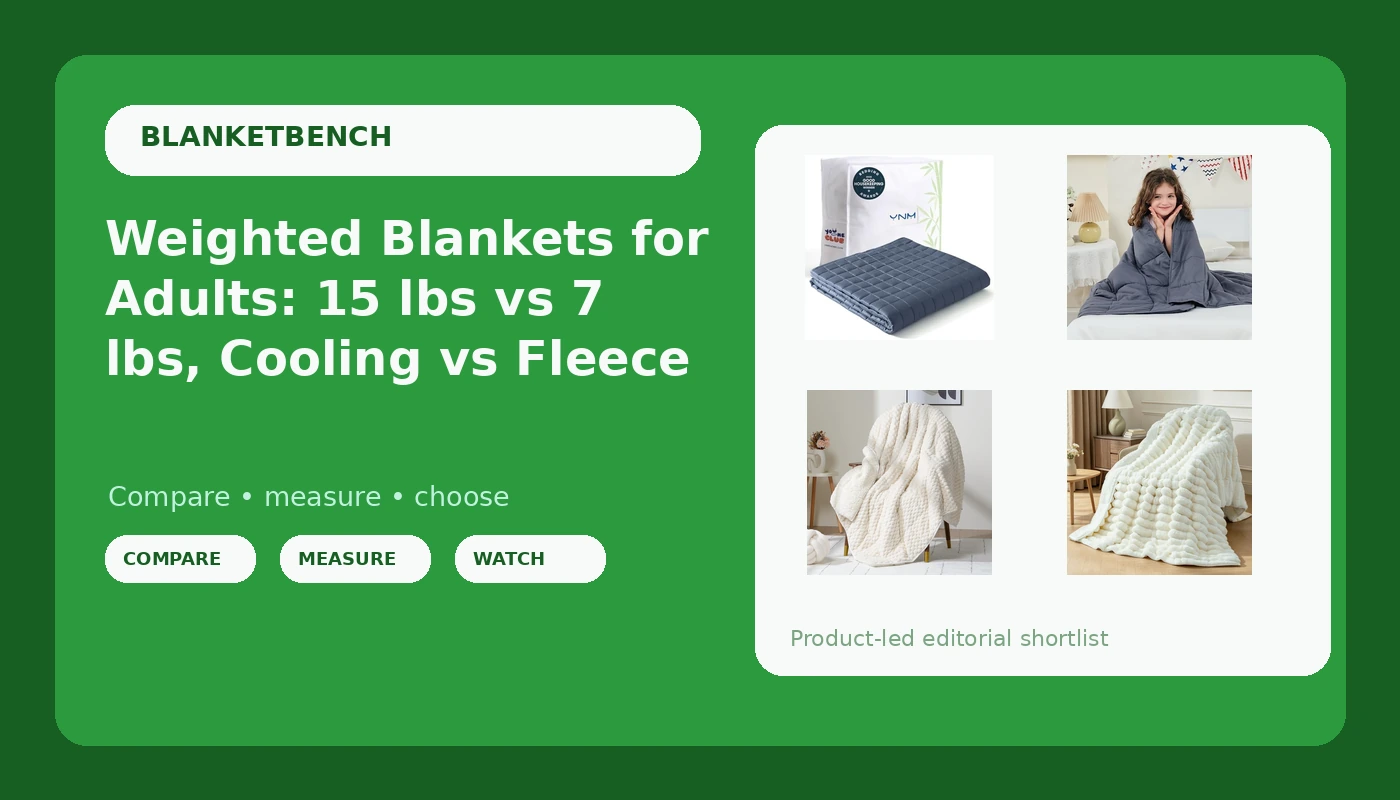
| YnM Cooling Weighted Blanket for Adults, 15lbs Heavy Bed Throw for One Person of 140lbs, Perfect for Hot Sleepers or Warm Climates with Cooling Rayon/Glass Beads (60x80 Inches, Queen Bed, Blue Grey) | Hot sleepers and warm bedrooms | Cooling rayon shell with glass bead fill in a 15 lb 60 x 80 inch size |
| Mr. Sandman Weighted Blanket for Adults, Queen Size 60 x 80 Inches, 15 lbs | A straightforward 15 lb queen | 15 lb fill in a 60 x 80 inch queen size, with no cooling or fleece claim attached |
| yescool Weighted Throw Blanket 7lbs, 41" x 60", Grey | Lighter coverage, lap use, smaller frames | 7 lb fill in a 41 x 60 inch throw size |
| Fleece Weighted Blanket for Adults 60" x 80" 15lbs Fuzzy Blankets, White | Cold bedrooms and winter use | Fleece shell over 15 lbs of fill in a 60 x 80 inch size |
The cooling option: YnM Cooling Weighted Blanket for Adults, 15 lbs
Heat is the number one reason a weighted blanket ends up folded at the foot of the bed, and it has nothing to do with how heavy the blanket is. A 15 lb blanket with a breathable shell can be far more usable in July than a 10 lb blanket in a non-breathable polyester cover. Rayon blends are one of the fabrics that handle moisture and airflow better than standard polyester, which is why a cooling shell is the first feature I look for in a client's setup, ahead of weight. The glass bead fill also matters here: glass is denser than plastic pellets, so a glass-filled blanket can hit 15 lbs with a thinner profile that traps less air against your body. If you sleep hot and want a full-bed option, this is the configuration that addresses the actual failure point. It is still a 15 lb blanket, so if you know you run warm and hate any weight on your legs, a throw may serve you better than any queen.
The no-frills queen: Mr. Sandman Weighted Blanket for Adults, Queen Size 60 x 80 Inches, 15 lbs
There is a real argument for choosing a blanket with no fabric story attached: you know exactly what you are buying, and the decision collapses to weight and size. That is what this one offers. The trade-off is that a neutral shell gives you no help in a warm bedroom, so if your sleep environment runs hot for half the year, you are relying on bedding layers and air conditioning to do the work the fabric will not. For a client who sleeps at a normal temperature, keeps the thermostat low, and wants a standard queen footprint, that is a perfectly reasonable place to land. The 60 x 80 inch size is also the practical choice if you want one blanket to cover a bed rather than drape over a lap.
The lighter throw: yescool Weighted Throw Blanket 7lbs, 41" x 60", Grey
People overbuy weight because heavier feels more serious, and then they cannot get comfortable underneath it. A 7 lb throw is roughly half the fill of the 15 lb queens above, and it changes the experience in two ways: less total pressure, and a much smaller area of coverage. For someone with a lighter frame, that combination is often the difference between a blanket that gets used nightly and one that gets kicked off at 2 a.m. It is also the sensible way to find out whether deep pressure helps you at all before spending on a full-size blanket. The obvious limitation is coverage: a 41 x 60 inch throw will not span a queen bed, so if you want the weight distributed across your whole body rather than concentrated on your torso and legs, this is not the shape for that job.
The fleece option: Fleece Weighted Blanket for Adults 60" x 80" 15lbs Fuzzy Blankets, White
Fleece is the opposite bet from cooling rayon, and it is the right bet for a lot of people for about five months of the year. Fuzzy shells hold warmth, which is wonderful in a cold bedroom and miserable in a warm one. If you live somewhere with real winters and you keep the house cool at night, a fleece shell means the blanket feels inviting rather than clinical when you get into bed. The honest trade-off is seasonality: this is the blanket most likely to be swapped out in spring, and fleece surfaces generally need more careful laundering than a plain woven cover, so read the care instructions on the listing before you commit. If you want one blanket to work year-round, a cooling shell is the more flexible pick.
Prices and availability may change. Product images, names, and retailer links must be matched by verified ASIN. Do not state a current price, rating, stock status, or measured result without current evidence.
What the 10% guideline actually means
The 10% rule gets repeated as if it were a prescription. It is not. It is a starting point, and it was never meant to be the final word on what any individual should sleep under. A 140 lb adult at 10% lands at 14 lbs, which is why 15 lb blankets are so common. But the same 15 lb blanket on a 110 lb sleeper is nearly 14% of body weight, and on a 200 lb sleeper it is 7.5%. Neither of those is automatically wrong. What matters is whether you can move comfortably underneath it, roll over without effort, and get out of bed without wrestling.
The mechanism people point to is proprioceptive input: the sense of where your body is in space, fed by pressure receptors in the skin and joints. Deep, even pressure appears to be calming for some people, which is the theory behind weighted blankets, weighted lap pads, and the pressure vests used in some clinical settings. The research on sleep outcomes is genuinely mixed, and placebo effects are real and hard to separate out in a product you can feel the moment you lie down. That does not make it useless. It makes it a sleep aid, one that works for some people and does nothing for others, and the only reliable test is a few weeks of honest use.
There is also a practical ceiling. A blanket heavy enough to be hard to move under is a blanket you will resent, especially if you are the kind of sleeper who shifts position a lot. If you are torn between two weights, start lighter. You can always add a second layer on cold nights, and a 7 lb throw under a 15 lb blanket is a genuinely useful combination in January.
Fabric, bead distribution, and stitch density
The shell fabric is the part of a weighted blanket you actually touch, and it decides breathability. Polyester covers are common because they are cheap and durable, but they hold heat and moisture against the skin, which is exactly what you do not want in a bed layer that already sits on top of you. Cotton, bamboo, and rayon blends move air and moisture better. In a city with humid summers, that difference is the whole ballgame.
Bead fill comes in two broad types. Glass beads are dense, so a glass-filled blanket reaches a given weight with less bulk. Plastic pellets are lighter and cheaper, so the blanket needs more fill volume for the same number of pounds, which usually means a puffier, warmer profile. Neither is a defect on its own, but if you run hot, denser fill in a thinner blanket is the configuration you want.
Then there is distribution, which is where cheap blankets fall apart. Weighted blankets are usually sewn into a grid of quilted channels, and the beads are meant to stay in their own square. When the stitching is sparse or the channels are too large, beads drift toward the edges and corners over weeks of use, and you end up with a heavy rim and a hollow middle. Look at how small the quilted squares are and how dense the stitching appears. Smaller channels mean the weight stays where it was designed to sit, and the blanket keeps its shape instead of turning into a sack that pools on your chest.
Finally, washability. A blanket that cannot be cleaned will not stay in rotation. Follow the care instructions that come with the specific blanket, use a machine large enough to let it move, and avoid anything that will stress the stitching.
A five-step way to choose
- Weigh yourself and calculate 10% as a starting number, not a target. Round toward the lighter blanket if you are between sizes.
- Decide whether you want full-bed coverage or lap-and-shoulder coverage. Queen sizes span a bed; throws concentrate pressure on a smaller area.
- Be honest about your bedroom temperature. Hot sleeper or warm climate, prioritize a breathable cooling shell. Cold bedroom, a fleece shell will get used more.
- Check the fill type and the quilted channel size, since glass beads in small channels hold their distribution better than large, sparsely stitched squares.
- Read the care instructions before buying. If laundering the blanket is impractical for you, you have found the reason it will end up in the closet.
Practical guidance before you buy
- Sleeping alone or with a partner matters. A 15 lb queen shared with another person means each of you gets partial coverage, not the full sensory effect.
- Layering is easier than committing to one heavy blanket. A 7 lb throw under a lighter duvet covers more temperature ranges than a single 20 lb blanket.
- Give it two to three weeks of consistent use before you decide. The first two nights are not a fair test of anything.
- Watch the corners and edges after a month. Bead migration shows up there first, and it is the clearest sign the channels are not holding.
- Weighted blankets are not a treatment for ADHD, autism, or any other condition, and they are not appropriate for infants or during pregnancy. If you are buying for a child, the blanket must be light enough that they can move it off themselves without help.
Which option should you choose?
Choose the YnM Cooling Weighted Blanket for Adults, 15 lbs when you sleep hot, live in a warm climate, or want a full-size 15 lb blanket whose shell will not turn your bed into a sauna. Choose the Mr. Sandman Weighted Blanket for Adults, Queen Size 60 x 80 Inches, 15 lbs when you want a plain 15 lb queen with no fabric claims attached and your bedroom temperature is not a problem. Choose the yescool Weighted Throw Blanket 7lbs, 41" x 60", Grey when you have a lighter frame, want lap-and-shoulder coverage, or want to test whether deep pressure helps you before spending on a full-size blanket. Choose the Fleece Weighted Blanket for Adults 60" x 80" 15lbs Fuzzy Blankets, White when your bedroom runs cold and you want the blanket that feels warm the moment you get under it.
The caveat that applies to all four: the evidence for weighted blankets improving sleep is mixed, individual responses vary widely, and a blanket that works beautifully for one person can be a nuisance for another. None of these products treats a medical condition, and none of them replaces sleep hygiene basics like a consistent schedule and a dark, cool room. Treat the purchase as an experiment with a clear test period, not as a fix.
The bottom line
Weight is the number everyone argues about and the least likely reason you will stop using a weighted blanket. Fabric breathability, bead distribution, and whether the thing can be washed are what separate a blanket that stays on the bed from one that lives in a closet. Start at roughly 10% of your body weight and adjust from there, lean lighter rather than heavier if you are unsure, and let your bedroom temperature pick the shell for you: cooling rayon if you sleep hot, fleece if you sleep cold, and a plain queen if you simply want the weight without a fabric story. All four options here are legitimate versions of that decision, and the right one depends far more on your sleep environment than on the label.