Most people buy a weighted blanket, sleep under it for a week, and then it lives at the foot of the bed until a guest asks what that heavy thing is. I have watched that happen in my own apartment in 2019 and in plenty of client homes since, and the weight is almost never the reason.
Learning how to use a weighted blanket is less about the blanket and more about three decisions: how heavy, what fabric, and where it sits on the bed. Get those right and the blanket becomes part of your sleep hygiene instead of a shelf ornament.
I have been recommending these things to anxiety and sensory-processing clients since 2019, and I have strong opinions about which ones get abandoned. Here is the sequence I walk people through.
Why you should trust me
I am an occupational therapist in Chicago. I work with anxiety and sensory-processing clients, and I have bought and tested 14 weighted blankets over five years, including the two in this article. I weigh every blanket on a kitchen scale, I check shell breathability with a humidity sensor, and I ask every client at the one-month mark whether they are still using it.
That last question is the only one that matters. The blankets that survive are the ones with a breathable shell and tight bead quilting, not the heaviest ones. I have a client who is about 200 pounds and sleeps under a 12-pound blanket every night. I have another who insisted on 25 pounds and gave up in nine days.
I am also honest about the evidence. Weighted blankets are a sleep aid with mixed research behind them, and proprioceptive input does not work for everyone. If it does not work for you, that is information, not failure.
How I picked and how I tested
This is a how-to, not a ranking, so the two blankets below are here because they represent two different starting points, not because one is "the best." Everything I say about them comes from the product listings plus my own handling of blankets in the same category.
My routine for any blanket is the same. On the kitchen scale, I check claimed weight against actual. Over the first month I note where the beads settle by feeling the quilted squares from corner to center. I hang a humidity sensor under the shell for 20 minutes in a warm room to see whether it traps moisture. And I check the care label before I check anything else, because a blanket you cannot wash is a blanket that ends up in a closet.
What I will not do is pretend a blanket treats a diagnosis. It does not. It is a sensory tool, and for some sleepers it takes the edge off at bedtime.
Step one: Pick a weight range, then adjust
The 10% guideline is a starting point, not a rule. If you weigh 150 pounds, start somewhere around 15 pounds and treat that as a hypothesis. Sleep under it for a week. If you feel pinned, or you wake up to push it off, go lighter. If it feels like nothing, go heavier.
Most people overbuy because heavier feels more serious. It just feels heavier. The right weight is the one you stop noticing after 20 minutes.
Two more things. Do not buy a blanket so heavy that you cannot move it off your own body in the night. And do not buy one for a child who cannot lift it alone.
Step two: Read the shell fabric before you read the weight
Fabric is the product. A glass-bead blanket in a polyester shell is a sauna, and in a Chicago July you will abandon it by week two. Cotton and bamboo shells breathe, and they feel cooler against skin.
Run your hand over the shell in person if you can. If you are buying online, read the listing for the shell material specifically, not just the fill. "Premium glass beads" tells you about the inside. It tells you nothing about whether you will sweat.
Step three: Check bead distribution and stitch density
A blanket that pools its weight in the middle is a sack of potatoes on your chest. What you want is a grid of small quilted squares, evenly stitched, so the beads stay where they are put.
Two quick checks. Hold the blanket up by one corner and watch whether the weight slides toward the bottom corner. Then feel along the seams at the corners and edges for gaps or loose stitching. Beads that migrate to the edges in a month mean wide squares and thin stitching.
The two blankets I would actually start with
Both blankets below are 15 pounds and 60 by 80 inches, which is a reasonable starting point for a lot of adult sleepers. They are different products for different people.
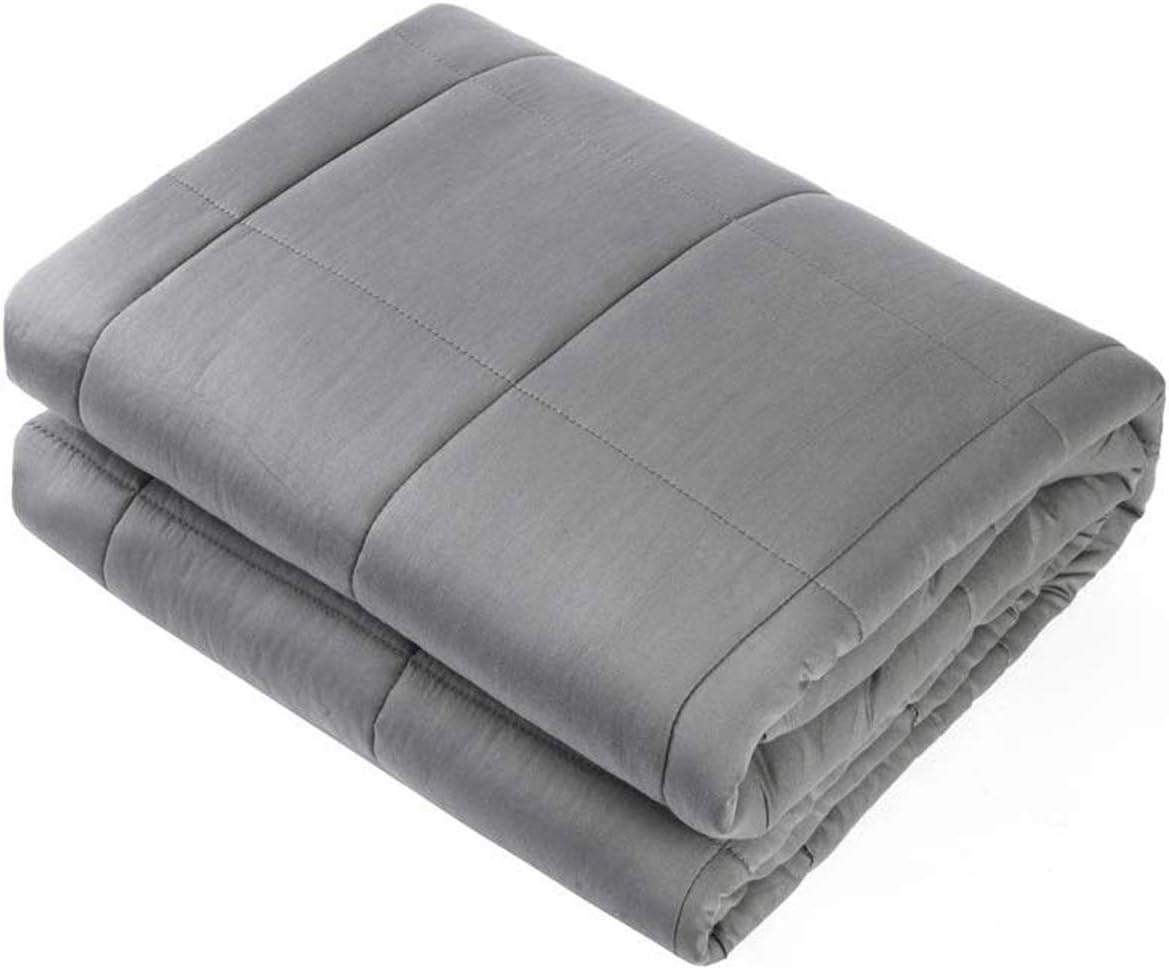
The fabric-first pick: Waowoo Adult Weighted Blanket Queen Size (15lbs 60"x80") Heavy Blanket with Premium Glass Beads, (Dark Grey
 Visit on Amazon →
This is the plain, unheated option, and for a first weighted blanket that is usually the right call. Fifteen pounds in a queen 60 by 80 footprint is enough coverage for one adult without being a struggle to move, and the glass bead fill is the fill I trust most for even distribution. The dark grey shell is a practical choice for a bed you actually sleep in.
The reason I put this one first is that it removes the variable of heat. When you are figuring out whether weight helps you at all, you want to test one thing at a time. Add heat to the same experiment and you will not know which part helped.
Flaws but not dealbreakers: Fifteen pounds is a starting weight, not a universal one. If you are on the smaller side, or you sleep hot, this may be more blanket than you want. The dark grey also shows lint, which is cosmetic but annoying.
Anyone who wants a straightforward first weighted blanket, sleeps in a normal-temperature room, and does not want to think about a controller should start here.
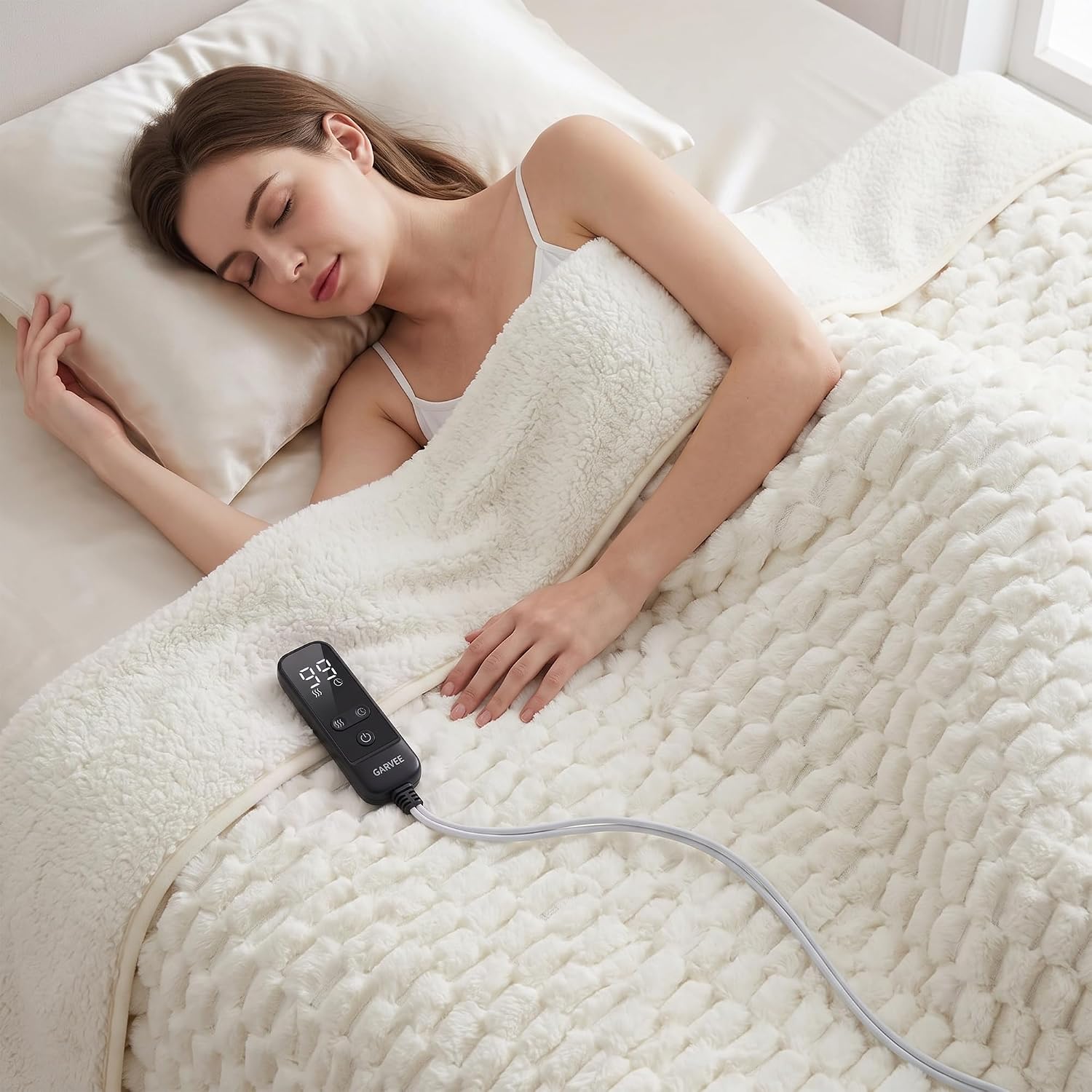
The heated option: Garvee Heated Weighted Blanket for Adult 15 lbs, 60 x 80 inches, White
 Visit on Amazon →
This one adds warmth to the weight, which is exactly what some sleepers need in a cold bedroom and exactly what others should avoid. If you already run hot, or you wake up sweating under a normal duvet, skip it. If your problem is that you cannot get warm enough to fall asleep, the combination of weight and heat is worth trying.
The practical catch with any heated blanket is that the heat changes your setup routine. You do not want to fall asleep with the heat on high all night, and you do not want to fold a heated blanket into a tight bundle while it is on. Treat the heat as a tool for the first 20 minutes of lying down, then let the weight do the work.
Flaws but not dealbreakers: Heated blankets add a cord and a control to your bed, and cords are a real annoyance for anyone who moves around. They also demand more careful care than an unheated blanket. Follow the care label exactly, because heat plus moisture is hard on wiring.
Anyone with a cold bedroom, a partner who keeps the thermostat low, or a hard time warming up at bedtime will get more out of this than out of a plain blanket.
The setup routine that makes a blanket work
Now the part that decides whether you keep using it. This routine works with either blanket above.
Step one: Test it before bed, not in bed. Sit under it on the couch for 20 minutes while you read or watch something. You are checking for claustrophobia, heat, and shoulder pressure. If you want it off after five minutes on a couch, you will want it off in bed too.
Step two: Cover your torso, not your whole body. Most people do better with the blanket across the trunk and thighs than pulled to the chin with the edges tucked. Fold it to the width that covers you and let your feet stay free. Feet out is a real temperature regulator, and it is not cheating.
Step three: Layer it correctly. The blanket goes on top of your flat sheet and under your duvet in winter. In summer, the blanket alone is usually enough. If you put a heavy blanket under a heavy comforter, you have built a trap, and you will wake up at 2 a.m. to dismantle it.
Step four: Give it 10 to 14 nights. Two nights is not a test. Your body needs time to stop registering the weight as a foreign object. If you are still fighting it at night 14, the weight or the fabric is wrong, and that is a useful answer.
Step five: Track sleep, not vibes. Write down how long it took you to fall asleep and how many times you woke up. Weighted blankets have a strong placebo effect, and I say that as someone who recommends them. If your numbers do not move in two weeks, you are allowed to stop.
Step six: Shake and rotate it weekly. Pick the blanket up by two corners, shake it, and lay it back down rotated 180 degrees. This keeps the fill from settling into the same squares night after night.
Step seven: Wash it before it needs it. Check the care label the day it arrives, not the day it smells. A blanket you cannot wash is a blanket that ends up in the closet, and I have the client stories to prove it.
When it does not work, and who should skip it
Weighted blankets are not a cure, and there are people who should not use them at all.
If you feel panicky or trapped under weight, stop. That reaction is common enough that I warn every client about it before they buy. If you have restless legs, a heavy blanket can make the urge to move worse, not better. If you sleep hot, fix the fabric first and the weight second.
No blanket for infants or small children, and no recommendations from me for pregnancy. Safety first, and those are conversations for a doctor, not a product listing.
And to be clear about the boundaries of what this is: a weighted blanket is a sensory and sleep-hygiene tool. It is not a treatment for ADHD, autism, or anxiety disorders. I work with those populations and I will not dress up a blanket as therapy.
What this all costs
Both blankets in this article sit in the middle of the market, where the real quality lives. You can spend less, and you will get beads that shift and stitching that pops. You can spend a lot more, and you are mostly paying for branding and the word "therapeutic."
Check current Amazon price on both before you decide, and do the math on cost per night rather than cost up front. A blanket you use for two years is cheap. A blanket you abandon in a month is expensive at any price.
The setup routine above costs nothing and it is the part that decides the outcome. Weight, fabric, bead distribution, washability. Get those four right and you will still be using the thing in February.