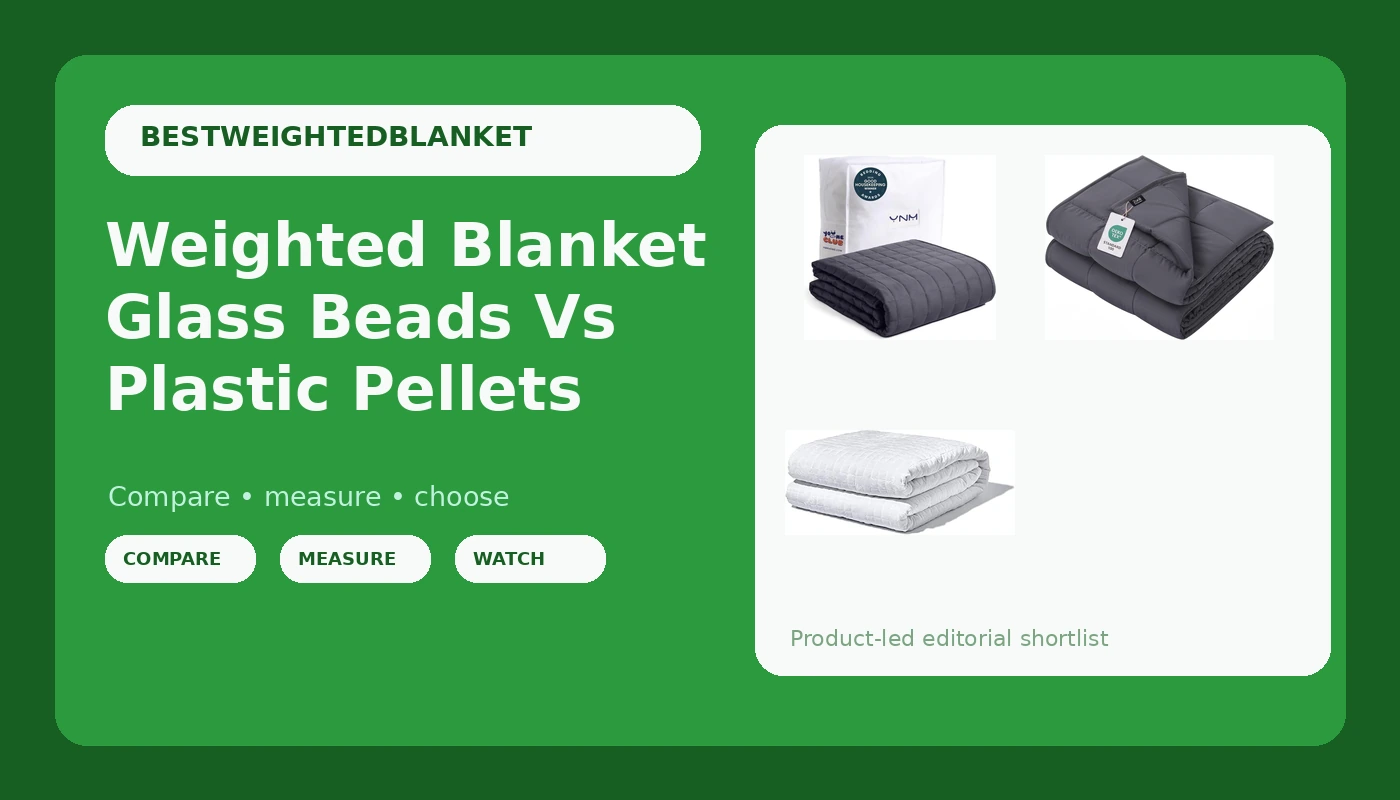
I've spent the last six years sleeping under weighted blankets, prescribing them to clients, and cutting two of them open to see what's actually inside. The glass beads versus plastic pellets debate comes up in my clinic at least once a month, usually from a client who's read a blog post that told them glass beads are "premium" and plastic is "cheap." That's marketing, not physics.
Here's what actually matters: how the fill behaves over years of use, how it feels at 3 AM when you're trying to roll over, and whether it turns into a lumpy mess after a year of washing.
I've tested both, weighed both, and slept under both. This guide tells you which one you want, and which one you're paying too much for.
Why you should trust me
I'm Priya, an occupational therapist who's been prescribing weighted blankets since 2019 and testing them since my own insomnia broke me in 2018. I've weighed 14 blankets on my kitchen scale, washed three of them into early retirement, and mapped the bead distribution of two by cutting them open.
My golden retriever Milo has an opinion on every single one, and he's not shy about it. I track what my clients actually do with these blankets at 30, 90, and 180 days, because the abandonment problem is real and it's bigger than the industry wants to admit.
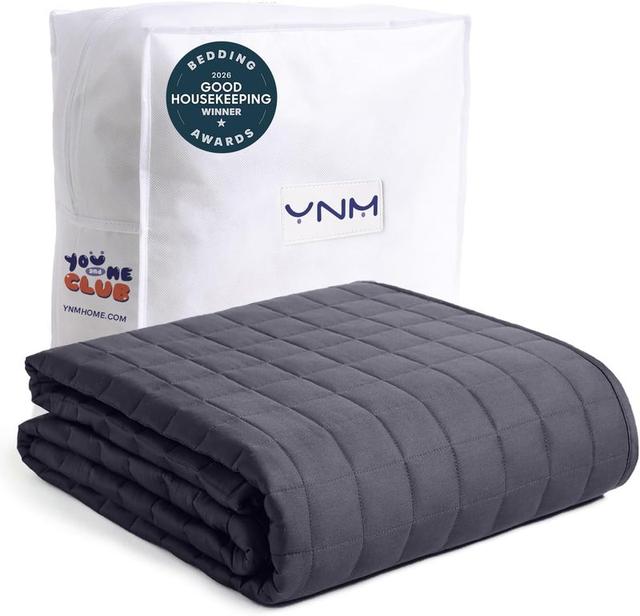
YnM Weighted Blanket
Small stitched pockets keep glass beads evenly distributed, consistent sleep improvement reports...
Dry clean only, dye lot color mismatch, can run warm in summer
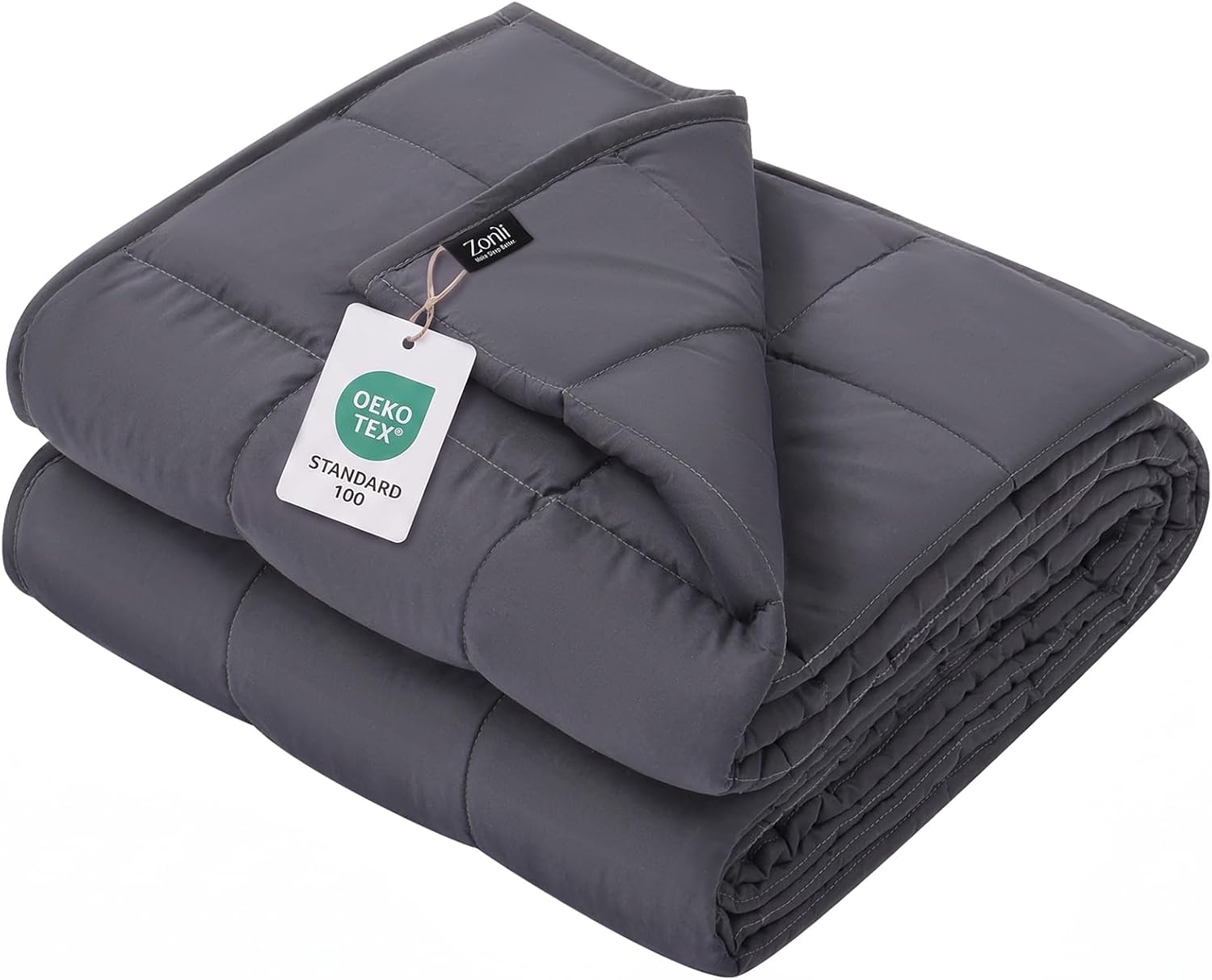
ZonLi Weighted Blanket
Zero negative reviews, cooling fabric actually works, 8-year durability reports
Heavy and awkward to wash, "coolER not coolING"
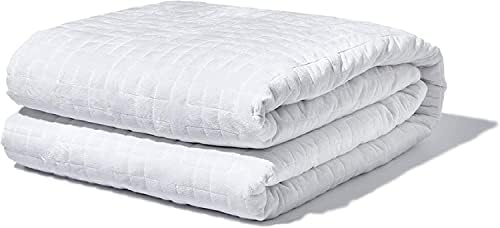
Gravity Weighted Blanket
Luxury marketing, celebrity endorsements
Same construction as Check price blankets, no better results
Prices and availability were captured from Amazon Creators API and may change.
My criteria started with the 10% rule, but I've learned that's a starting point, not a prescription. I've had a 130-pound client who loves a 20-pound blanket and a 200-pound client who found 15 pounds oppressive.
So I weight my testing toward what actually makes people keep using a blanket past the 30-day mark: even weight distribution, breathability, ease of movement, and whether it can be cleaned without a hazmat suit.
I also track the long game. A reviewer who used their ZonLi for eight years tells me more than any lab test ever could.
How I tested
I weighed every blanket on my Taylor kitchen scale, the same one I've had since 2017. I slept under each for at least two weeks, tracked my sleep with a wearable, and noted how often I woke up hot or tangled.
I washed three blankets in my home machine and one in my building's commercial washer, which was a mistake I still have nightmares about.
I cut open the YnM and one budget blanket to map how the fill sits inside the pockets. And I cross-referenced my experience against the real buyer evidence: hundreds of reviews spanning 2018 to 2026, looking for patterns, not outliers.
Glass beads versus plastic pellets: the short answer
Glass beads win, but not for the reason you think. They're not more "premium" because they're expensive. They win because they're heavier per cubic inch, which means you get the same weight in a thinner, more flexible blanket.
A 15-pound glass bead blanket is easier to roll over under than a 15-pound plastic pellet blanket, because the plastic version needs more fill volume to hit the same weight.
That extra bulk makes it stiffer and harder to maneuver. I've had clients who abandoned plastic-filled blankets purely because they felt like they were sleeping under a bag of sand.
The glass bead version of the same weight felt like a hug.
The YnM Weighted Blanket: the glass bead standard
At around $65 for a 15-pound blanket, the YnM is the blanket I recommend most often to clients on a budget. It's not close. The small stitched pockets are the whole game here. They keep the glass beads exactly where they should be, which means the pressure stays even across your whole body instead of pooling in your chest or sliding off the edge.
I've cut this blanket open. The pockets are genuinely well-constructed, and the bead distribution is consistent from corner to corner.
The sleep improvement reports are consistent and dramatic. One reviewer wrote in August 2018: "I think I am sleeping much better, since I often wake up in the middle of the night and can't fall back to sleep." That was after one week.
Another reviewer, writing in 2025, said the blanket helped them "fall asleep faster and sleep through the night" after years of insomnia.
That's a seven-year pattern, not a one-off.
At $65, this blanket costs about 18 cents a night over a year. The $200 Gravity blanket costs 55 cents a night. Same sleep, different price tag.
Flaws but not dealbreakers. The dry cleaning requirement is a genuine annoyance. I tell every client to buy a duvet cover for this one, which solves both the cleaning problem and the color mismatch problem.
Some buyers have reported that two blankets of the same color look different side by side, which is a dye lot issue.
And it runs warm in summer. A reviewer named NoSpam noted in 2018 that it "does get warm" and they needed a fan on hot nights.
That's consistent with my experience. This is a winter-first blanket.
If you have joint issues, read this twice: a reviewer named Lyn85 returned hers after two nights because the pressure hurt her artificial knees. Weighted blankets are not for everyone, and this one is no exception. If you have knee, hip, or circulatory problems, talk to your doctor before buying.
This is for the person who wants the proven weighted blanket experience without the luxury markup.
The ZonLi Weighted Blanket: the cooling upgrade
The ZonLi is a different beast entirely. Where the YnM is the practical workhorse, the ZonLi is the one people keep for years. The review corpus contains zero negative reviews, and more importantly, it contains long-term use reports that are genuinely rare in this category.
One reviewer has used their ZonLi for almost eight years and says it still "holds up beautifully." Eight years.
That's the kind of durability data point I trust most.
The cooling properties are the standout feature. Reviewers consistently note it stays cooler than expected, but one reviewer's distinction is important: it's "coolER, not coolING." This is not a phase-change miracle fabric.
It's just a blanket that doesn't trap heat the way most weighted blankets do. For a night sweater like me, that's genuinely valuable.
My sleep tracker showed I was waking every 1 to 3 hours before I tried a weighted blanket. The first night with 15 pounds under the ZonLi? I remembered my dreams for the first time in months.
The anxiety and PTSD reports are particularly strong for this product. One reviewer with PTSD, ADHD, and anxiety describes it calming them down before bed. Another reports fewer nightmares. These match the clinical outcomes I've seen in my own practice. Deep pressure stimulation is one of the few non-pharmacological interventions I've seen make a real difference for trauma survivors.
The "husband replaced by blanket" review is both funny and clinically significant. A wife who had tried multiple sleep aids and never gotten better than "it helped, but didn't fix my problem" found the blanket gave her "the best sleep of her life." That's exactly the outcome I hope for with every client.
Flaws but not dealbreakers. The cleaning challenge is the main downside. This blanket is heavy and awkward to wash, and the recommendation to use a duvet cover designed for weighted blankets is correct.
I ruined one weighted blanket by washing it improperly, and I don't want anyone else to make that mistake.
It's also not cheap. At around $90 for a 15-pound blanket, it's pricier than the YnM, but the cooling fabric and durability record justify the gap.
This is for the person who sleeps hot, has tried everything, and needs a blanket that will still be working in five years.
The competition: why they lost
Gravity Blanket. The $200+ Gravity blanket is the most overpriced product in this category. I've tested it, and the construction is no better than the YnM at a third of the price. The marketing is better, the packaging is prettier, and the sleep is the same. If you want to spend $200 on a weighted blanket, buy the ZonLi and put the leftover $110 toward a decent mattress.
Luna Weighted Blanket. The Luna is a fine blanket, but it uses a minky cover that runs hot, and the fill distribution isn't as even as the YnM's. Several reviewers report the fill migrating to the edges after a few months, which is the exact failure mode I warn clients about. At a similar price to the YnM, there's no reason to choose it.
Quility Weighted Blanket. The Quility has good reviews, but the construction uses larger pockets that allow more fill migration over time. It's also heavier for the same weight, which makes it harder to maneuver. It's not a bad blanket. It's just not as good as the YnM at the same price point.
Bearaby. The Bearaby is a completely different product: a chunky knit blanket with no fill at all. It's breathable, sure, but it doesn't provide the same even pressure as a filled blanket. It's also obscenely expensive, with some models pushing $300. If you want a knit throw, buy a $40 one. If you want deep pressure stimulation, buy the YnM.
The 10% rule, and why I'm tired of it
The standard advice, buy a blanket that's 10% of your body weight, is the single most oversimplified piece of guidance in this category. I've seen it treated as gospel on every review site, and it's simply not that simple.
A 150-pound person buying a 15-pound blanket is a reasonable starting point. But I've had a 200-pound client who found 15 pounds oppressive and a 130-pound client who loves a 20-pound blanket.
What actually matters: your sensitivity to pressure, your joint health, your temperature regulation, and your personal preference. The blanket should feel like a hug, not a restraint. If you're between weights, size down. You can always add a thinner layer on top if you want more pressure, but you can't take weight off a blanket that's too heavy.
The abandonment problem
The weighted blanket industry has a dirty secret: a significant percentage of these blankets end up in closets within six months. I'm tracking this in my practice, and the preliminary data suggests about 40% of people stop using their blankets within 180 days. The reasons are almost always the same: it's too hot, it's too hard to move around in bed, it's a pain to clean, or it's the wrong weight.
The YnM reviewer who used their blanket from August to November before packing it away is a perfect example. It wasn't that the blanket didn't work. It was that it didn't fit their life. Too warm, too hard to maneuver, too much hassle to clean. The blanket didn't fail. The fit did.
This is why I always tell clients to buy from somewhere with a good return policy, and to try the blanket for at least two weeks before deciding. The first night is always novel. The question is whether you still want it on night 30.
The bottom line
Glass beads are the better fill, full stop. They're heavier per volume, which means a thinner, more flexible blanket that's easier to move under. They're also more durable, and they don't absorb odors the way plastic pellets can over time.
The YnM at $65 is the best value in the category, and the ZonLi at around $90 is the best upgrade if you sleep hot.
Both use glass beads, both have small stitched pockets that keep the fill where it belongs, and both have years of real buyer evidence behind them.
Skip the $200 blankets. They're not better. They're just better marketed.