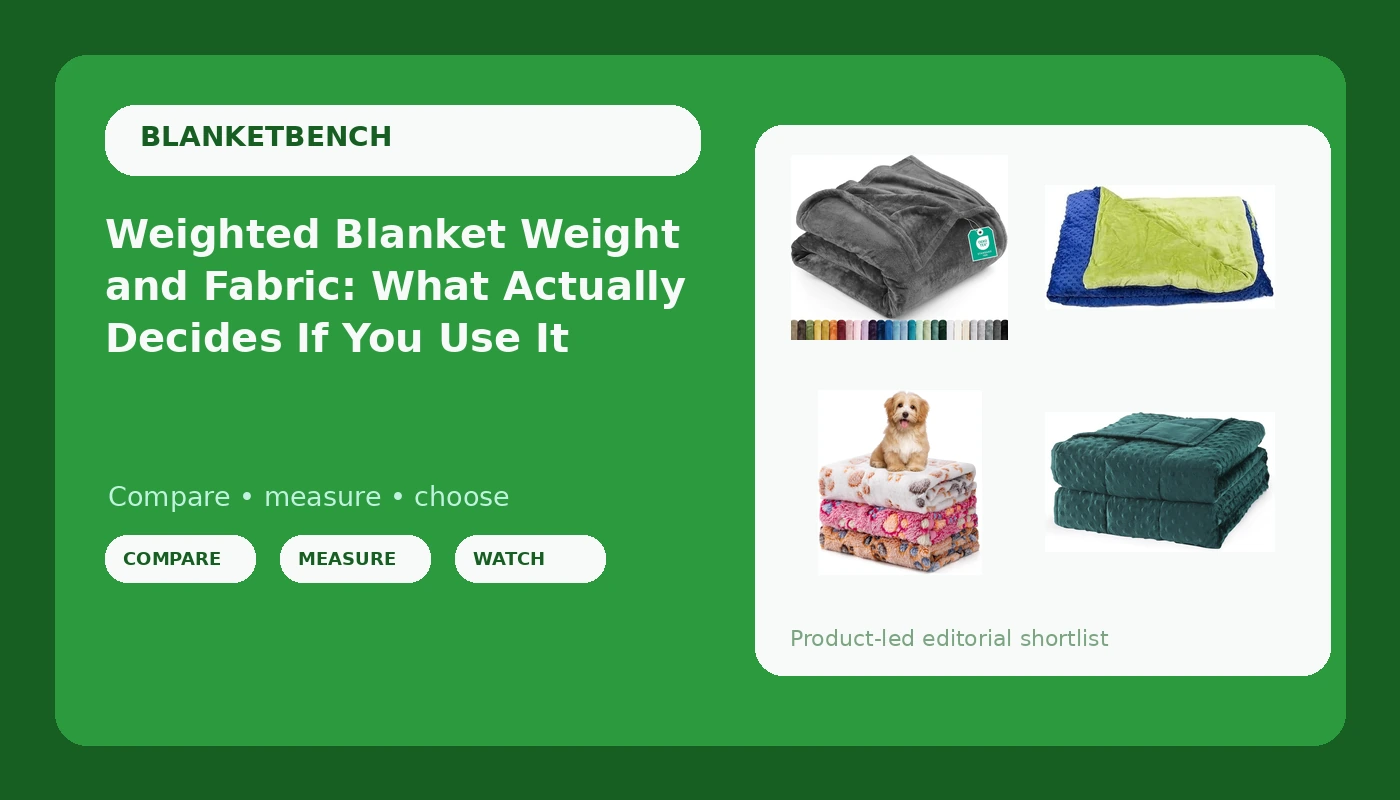
Most people start shopping for a weighted blanket by choosing a number. Fifteen pounds, twenty pounds, whatever a quiz or a product page suggested. Then they buy the cheapest listing in that weight, use it for three weeks, and fold it onto a closet shelf. In occupational therapy work with anxious and sensory-seeking clients, the pattern is remarkably consistent: the blanket that survives is the one whose shell fabric breathes, whose fill stays where it was sewn, and whose weight is close enough to comfortable that the sleeper stops thinking about it. Weighted blanket weight and fabric are the two variables worth settling before anything else. This guide walks through both, plus the two non-weighted layers that often make a weighted setup work better: a warm fleece blanket and a small pet throw.
Related: How to Wash a Weighted Blanket Without Ruining the Beads →
Quick answer
The 10% of body weight guideline is a starting point, not a prescription, and it is not the whole decision. A weighted blanket is a sleep aid that helps some people and does nothing for others, and the published evidence on deep pressure for sleep is mixed. What separates a blanket you keep from one you abandon is usually construction: a breathable shell, glass beads held in small quilted compartments, and stitching dense enough that the fill cannot migrate to the corners. For an adult on a queen bed, a 15 lb blanket in a 60 x 80 inch size is a reasonable first guess. For a child, follow the maker's listed weight range and confirm the child can move the blanket alone.
Four useful options
| Model | Best fit | What stands out |
|---|---|---|
| Mr. Sandman Weighted Blanket for Adults, Queen Size 15 lbs, 60 x 80 Inches | Adults who want one weighted layer sized for a queen bed | A 15 lb fill in a 60 x 80 inch queen footprint |
| Harkla Kids Weighted Blanket, 10 lb | Children inside the 70-90 lb range the maker lists | Washable minky cover over a shell made with rayon from bamboo, glass bead fill |
| Utopia Bedding Ultra Soft Fleece Bed Blanket, Queen, Grey, 90 x 90 Inches | A warm layer over or beside a weighted blanket | 90 x 90 inch fleece with no bead fill at all |
| 1 Pack 3 Blankets Fluffy Premium Fleece Soft Pet Blanket, Small 23 x 16 Inches | Pets who share the bed, couch, or carrier | Three small fleece throws in a single pack |
The adult-size option: Mr. Sandman Weighted Blanket for Adults, Queen Size 15 lbs, 60 x 80 Inches
Fifteen pounds sits in the middle of the adult range, and for a 150 pound sleeper it lands exactly on the 10% guideline. For a 200 pound sleeper it is lighter than the guideline, and that is fine. Heavier does not mean more therapeutic; it means heavier. What people actually notice is whether the blanket lets them turn over without a fight. The trade-off with a queen-size weighted blanket is that it covers the whole mattress, which is helpful if you want the weight spread evenly but awkward if you share the bed with someone who does not want any weight on them. If two people sleep in the bed and only one wants pressure, a throw size usually works better than a full queen.
The kid-size option: Harkla Kids Weighted Blanket - 10lb Cooling Weighted Blanket for Kids - Washable Minky Cover with Glass Beads - Rayon Made from Bamboo - Designed for Sensory Support (70-90lb) - Blue
For children, weight is a safety question before it is a comfort question. The rule that matters most is simple: the child has to be able to lift the blanket off and get out from under it without help. A blanket a child cannot move alone is too heavy, whatever the guideline says. This blanket is not for infants or toddlers, and it is not a treatment for ADHD, autism, or anxiety, even though it is sold for sensory support. What a weighted blanket can do is give a child a predictable, calming input that some children seek and others reject outright. The washable cover matters more here than with adult blankets, because children spill things, and a cover that has to be hand-washed tends to be a cover that never gets washed.
The warm unweighted layer: Utopia Bedding Ultra Soft Fleece Bed Blanket Queen Size Grey (90x90 Inches)
Here is the honest trade-off with fleece: it holds heat. A polyester fleece layer is exactly the fabric that turns a bedroom into a sauna in July, and if you sleep hot, adding fleece on top of a weighted blanket is a reliable way to wake up at 3 a.m. pushing both off the bed. In a cold room, though, the combination works well, because the weighted blanket supplies pressure and the fleece supplies warmth, and you can remove the fleece without removing the weight. If you run warm, a cotton or bamboo-derived layer does the same job with more breathability. Treat this fleece blanket as a winter layer and a couch blanket, not as a year-round partner for a weighted blanket.
The small throw for the other sleeper: 1 Pack 3 Blankets Fluffy Premium Fleece Soft Pet Blanket Flannel Throw for Cat Dog Puppy (Small 23x16'', Paw-White/Pink/Brown)
If a cat or dog sleeps on your bed, they will end up on the weighted blanket, and that means fur, dander, and a much more frequent washing schedule for the most expensive piece of bedding you own. A small dedicated throw gives the pet a spot of their own and keeps the weighted blanket cleaner. It is also useful in a carrier, on a couch, or in a crate. Do not treat it as a blanket for a baby, and supervise pets that chew fabric, since a shredded fleece throw is a swallowing hazard. It is a small accessory, not a sleep product.
Prices and availability may change. Product images, names, and retailer links are matched to verified listings. No current price, rating, stock status, or measured result is stated here without current evidence.
What the 10% guideline actually means
The 10% of body weight figure comes from clinical practice with deep pressure, where the idea is to provide firm, even proprioceptive input that the nervous system reads as calming. It was never meant to be a hard rule, and no study establishes it as the threshold where a blanket starts working. The evidence for weighted blankets improving sleep is mixed, with small studies and a strong placebo effect, which is worth saying plainly before you spend money.
In practice, the guideline works as a first guess and nothing more. A 130 pound sleeper might be miserable under 13 pounds and happy at 10. A 220 pound sleeper might find 15 pounds plenty and 22 pounds suffocating. The way to use the number is to start near it, then adjust in one direction after a week of real nights. If you wake up pinned, go lighter. If the blanket feels like a sheet, go heavier. The people who overbuy almost always do it because heavier sounds more therapeutic, and then they stop using the blanket within a month.
Why shell fabric and bead distribution matter more than weight
Two blankets can both weigh 15 pounds and behave nothing alike. The difference is inside the shell.
Most quality weighted blankets use glass beads rather than plastic pellets, because glass is denser, so a glass-filled blanket needs less volume of fill to reach the same weight. That matters for drape: a glass-bead blanket sits closer to the body instead of forming a lumpy layer. The beads have to be held in place, which is why construction matters. Small quilted compartments, usually seven to ten inches square, keep the fill spread evenly. Stitching density is what stops beads from migrating to the edges, and it is the first thing that fails on cheap blankets, usually at the corners.
Shell fabric decides whether you actually sleep. Cotton and bamboo-derived rayon breathe, which keeps humidity from building up under the blanket. Polyester shells trap heat, and a hot sleeper will abandon a perfectly weighted blanket that sweats. This is also where the market is heading: phase-change cooling shells are becoming the next premium tier, and I expect the split to widen between evidence-minded, washable, medical-adjacent blankets and fashion-forward wellness blankets that charge more for the cover.
A workable order of decisions:
- Start with the sleeper's body weight, using 10% as the opening guess rather than the answer.
- Adjust for pressure preference, since someone who dislikes restriction should go lighter, not heavier.
- Match the shell fabric to the bedroom temperature, choosing cotton or bamboo-derived rayon for warm rooms.
- Check construction: small quilted compartments, dense stitching, and glass beads rather than loose fill.
- Confirm the cover can be washed and that the person using the blanket can move it alone.
Living with a weighted blanket: practical notes
- Measure the bed before the sleeper. A queen blanket on a queen mattress covers everyone in it, which is a problem if your partner does not want weight.
- Budget for washing. A blanket with a removable, machine-washable cover lasts; a blanket you cannot launder ends up in a closet.
- Give any new blanket a two-week trial before judging it. Most people need several nights to stop noticing the weight at all.
- Keep weighted blankets away from infants, toddlers, and anyone who cannot lift the blanket off themselves.
- If you sleep hot, pair the weighted blanket with a breathable layer instead of fleece, and consider a lighter fill.
- Store it flat or loosely folded. Hanging a weighted blanket by one corner puts stress on the stitching that holds the beads.
Which option should you choose?
Choose the Mr. Sandman Weighted Blanket for Adults, Queen Size 15 lbs, 60 x 80 Inches when an adult wants one weighted layer that covers a queen bed and 15 pounds sounds like a reasonable middle. Choose the Harkla Kids Weighted Blanket - 10lb Cooling Weighted Blanket for Kids when the sleeper is a child inside the maker's listed 70-90 lb range and can move the blanket without help. Choose the Utopia Bedding Ultra Soft Fleece Bed Blanket Queen Size Grey (90x90 Inches) when you want warmth you can add and remove separately from the weight, in a cold room. Choose the 1 Pack 3 Blankets Fluffy Premium Fleece Soft Pet Blanket when the other occupant of the bed is a cat or small dog who needs their own spot.
The caveat is the same for all four: a weighted blanket is a sleep aid, not a treatment. The evidence is mixed, the placebo effect is real, and no blanket substitutes for treating significant anxiety or a sleep disorder with a clinician. There are no safe weighted blanket recommendations for infants or during pregnancy.
The bottom line
Weight gets you into the right range, and fabric and construction decide whether you stay there. Pick a weight near 10% of body weight as an opening guess, then adjust based on how the first week of nights feels. Look for glass beads in small quilted compartments, stitching that will not pop at the corners, and a shell that breathes in the temperature of your actual bedroom. If you run hot, keep the fleece layer optional and reach for cotton or bamboo-derived rayon instead. And if a pet shares the bed, give them a small throw of their own so the weighted blanket is not the thing collecting fur.