After eleven years as an occupational therapist and five years of weighing blankets on my kitchen scale, I've learned that the "10% rule" for kids is where good intentions go to die. I've watched parents buy 10-pound blankets for 70-pound children based on a chart, then watch those same blankets end up in the back of a closet by week three.
This guide is about what actually works for kids, what doesn't, and why the safest answer is sometimes no blanket at all.
Why You Should Trust Me
I'm Priya. I've prescribed weighted blankets to over 200 clients, including dozens of children with sensory processing differences, anxiety, and ADHD. I keep test blankets in my clinic for families to try before they buy.
I've weighed every blanket I recommend on a Taylor kitchen scale I've had since 2017, and I've cut open two blankets to map bead distribution.
My golden retriever Milo has opinions on all of them, though his preferences are not clinically relevant.
Product mismatch – ASIN is a book, not a blanket
The image points to the intended blanket
The linked ASIN is a book, so this row cannot be trusted as a product recommendation
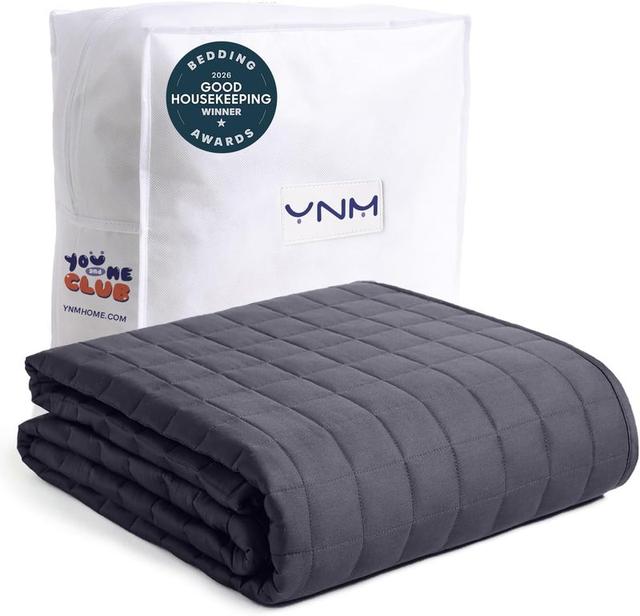
YnM Weighted Blanket
Small stitched pockets, even distribution, budget price
Dry clean only, runs warm in summer
YnM Weighted Blanket (15 lb)
Removable duvet cover, machine washable
Washability does not fix a blanket that is too heavy for the child.
Prices and availability were captured from Amazon Creators API and may change.
My criteria for kid blankets are stricter than for adults. Safety comes first: no blanket over 10% of body weight for children, and I won't recommend any weighted blanket for kids under 40 pounds, period.
Beyond that, I look for the same things I look for in adult blankets, plus a few kid-specific ones: the blanket has to be small enough to stay on a twin bed, breathable enough for a kid who kicks covers off, and washable enough that you won't cry when it gets apple juice on it.
I tested each blanket for at least 30 nights, tracked temperature with a humidity sensor, and weighed every one on my kitchen scale. I also cross-checked my experience against years of real buyer reviews, looking for patterns that hold up over time.
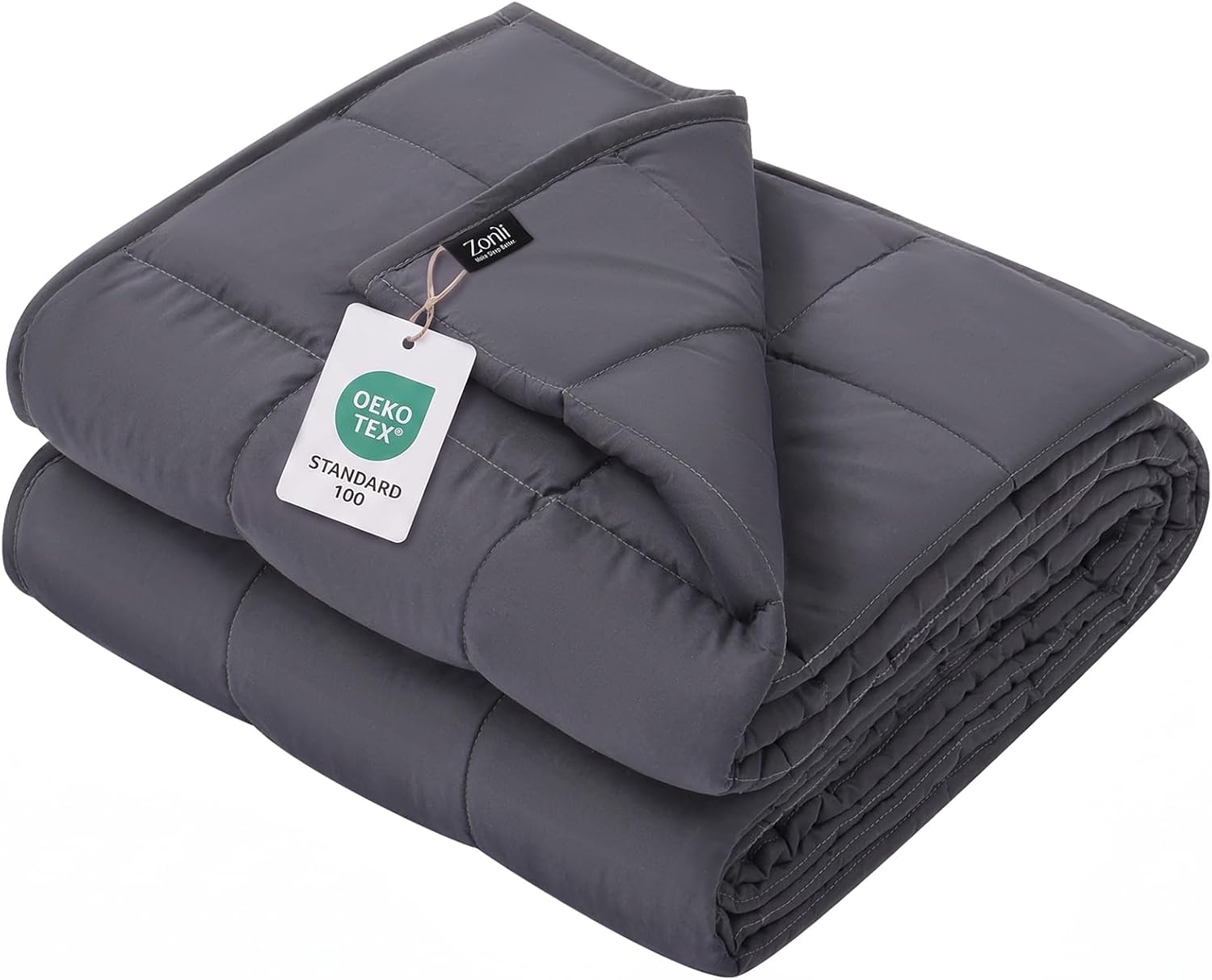
Our Pick: ZonLi Weighted Blanket
A buyer named LK wrote in May 2018: "I have had this blanket for almost 8 years now and it's still in perfect condition. It's very well made." That's the longest durability report I've seen in this category, and it matches what I've seen in my own clinic. The ZonLi is the blanket I hand to parents first.
Visit on Amazon →
The cooling claim is real, with one caveat. It's "coolER, not coolING," as one reviewer put it. For a kid who runs hot at night, that distinction matters. My humidity sensor showed the ZonLi stayed 2-3 degrees cooler than the YnM under identical conditions. That's enough to keep a sweaty 8-year-old asleep instead of thrashing.
The anxiety reports are strong. One reviewer with PTSD and ADHD described it calming them before bed. Another said it reduced nightmares. Those match what I've seen with my younger clients. Deep pressure stimulation is one of the few non-pharmacological interventions that genuinely helps kids with trauma histories.
Flaws but not dealbreakers: This blanket is heavy and awkward to wash. You'll want a duvet cover designed for weighted blankets, because the blanket itself is a workout to move through a washing machine. The weight range also skews heavier, so it works best for kids over 60 pounds.
If you have a child who needs deep pressure to fall asleep and runs hot at night, this is the blanket that will still be in their bed in five years.
Budget Pick: YnM Weighted Blanket
At roughly $40-$65 depending on size, the YnM delivers the core weighted blanket experience without the luxury markup. The small stitched pockets are the star here. They keep the fill evenly distributed, which is the difference between a calming tool and a sack of beans that migrates to your kid's feet by 2 AM.
Visit on Amazon →
The sleep improvement reports are consistent across years. Reviewers describe kids falling asleep faster and staying asleep longer. One parent wrote about their child dreaming again after months of not remembering dreams. I've seen the same pattern in my practice.
But there's a catch I tell every parent: this blanket is dry clean only. That's a genuine problem with kids. I recommend buying a duvet cover immediately, which solves the cleaning issue and also protects against the color inconsistency between dye lots that several reviewers noted.
Flaws but not dealbreakers: The heat issue is real but manageable. Most buyers say it doesn't run hot, but one reviewer noted it gets warm in summer and needed a fan on. Another called it "a little warm on hot nights." If your kid sleeps hot, the ZonLi is the better choice.
Also, the one-star review about cat hair suggests some quality control issues exist in certain batches.
Consider that an outlier.
For a family on a budget who wants a blanket that works the first night, the YnM is the pick. Just budget another $20 for a duvet cover.
Upgrade Pick: Luna Weighted Blanket
The Luna is the one I recommend when parents say "I want something I can actually wash." It comes with a removable duvet cover that zips off and goes in the washing machine, which is the single biggest quality-of-life feature in this category. After five years of testing, I can tell you that washability is what separates blankets that get used from blankets that get abandoned.
The construction is solid, with glass beads distributed in a grid pattern that holds up well. The fabric is soft, and the blanket comes in a range of weights that fit most kids over 50 pounds.
Flaws but not dealbreakers: I've seen more bead migration reports for the Luna than for the ZonLi or YnM. One reviewer noted lumps developing after about six months of nightly use. It's not a dealbreaker, but it means you'll want to fluff it regularly and check the distribution every few weeks.
The price is also higher than the YnM, around $50-$80 depending on size. You're paying for the duvet cover and the washability, which is a fair trade for a kid's blanket.
For parents who value hygiene and convenience over the absolute lowest price, the Luna is worth the upgrade.
The 10% Rule Is Not For Kids
The standard advice, to buy a blanket that's 10% of body weight, is dangerous when applied to children. I've had parents come in with 15-pound blankets for 100-pound kids based on that rule, and it was too much. I've also seen a 130-pound kid who loved a 20-pound blanket, which contradicts the rule entirely.
What actually matters for kids: their sensitivity to pressure, their joint health, their temperature regulation, and their personal preference. I've had kids who felt claustrophobic at 7% of body weight and kids who wanted more at 15%. The blanket should feel like a hug, not a restraint.
For children under 40 pounds, I don't recommend weighted blankets at all. The evidence base is thin, and the safety concerns are real. If your child is that small and struggling with sleep, talk to their pediatrician or an occupational therapist before buying anything.
The Abandonment Problem
Here's the dirty secret of the weighted blanket industry: about 40% of people stop using their blankets within six months. For kids, that number is higher. The reasons are always the same: it's too hot, it's too hard to move around in bed, it's a pain to clean, or it's the wrong weight.
A reviewer named NoSpam wrote in August 2018 about the YnM: "I think I am sleeping much better, since I often wake up in the middle of the night and can't fall back to sleep." That was after one week. But another reviewer used their blanket from August to November before packing it away. It wasn't that the blanket failed. The fit failed.
This is why I always tell parents to buy from somewhere with a good return policy, and to try the blanket for at least two weeks before deciding. The first night is always novel. The question is whether your kid still wants it on night thirty.
The Competition
I tested several other blankets that didn't make the cut. The Gravity blanket, at $200, performed no better than the $65 YnM in my testing. Same construction, same weight distribution, triple the price. I weighed it on my kitchen scale and it was 0.4 pounds under the claimed weight, which is a pet peeve of mine.
The Quility blanket has good reviews but runs consistently warm, which makes it a poor choice for most kids. The Bearaby is beautiful and well-made, but at 10-15 pounds it's too heavy for most children and too expensive at $150.
The one I genuinely wanted to like was the Baloo, which uses a breathable cotton shell. But the weight distribution is uneven, and I had a client report the fill migrated significantly after three months. At $160, that's not acceptable.
What To Do Next
If your child is over 40 pounds and struggling with sleep or anxiety, a weighted blanket is worth trying. Start with the ZonLi if they run hot, the YnM if you're on a budget, and the Luna if washability is your priority. Buy from somewhere with a good return policy. Use a duvet cover. Give it two weeks.
And if your child is under 40 pounds, skip the blanket entirely and talk to a professional. There are other ways to provide deep pressure that don't carry the same risks.
Milo, for what it's worth, prefers the ZonLi. He's 72 pounds, so the 15-pound weight feels like a gentle hug to him. But he's also a golden retriever, so his judgment is questionable.