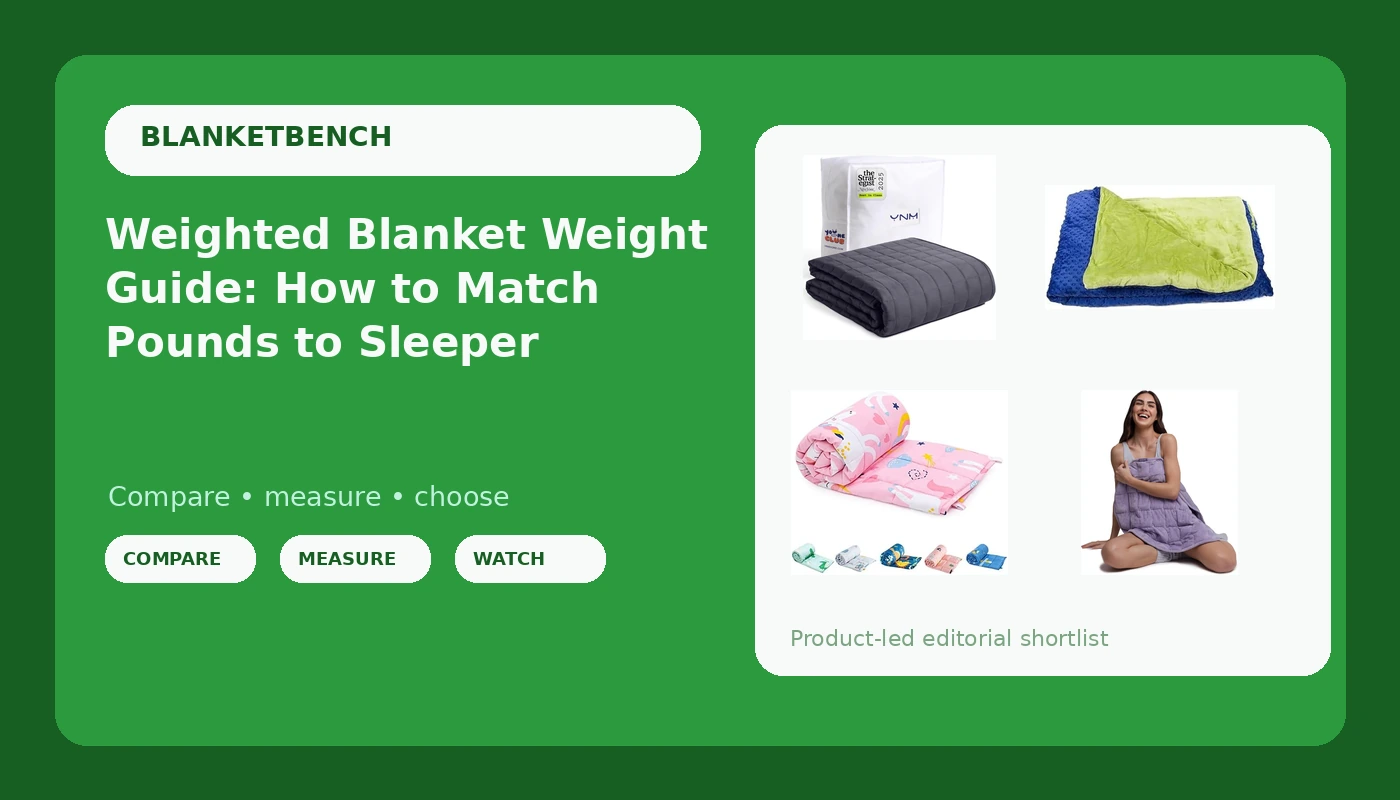
Most people who give up on a weighted blanket do not give up because the number on the label was wrong. They give up because the shell fabric turned the bed into a sauna, because the beads slid into the bottom third of the blanket, or because the size never matched the way they actually sleep. Weight is still where every purchase starts, and it is the easiest part to get roughly right. This weighted blanket weight guide works through the number first, then through the parts that decide whether the blanket is still on your bed in November: fabric, fill distribution, size, and washability.
Related: Weighted Blanket Safety: Who Should Skip One →
Quick answer
There is no single correct weight, and nothing here is being called the best. A common starting point is about 10 percent of body weight, then adjust up or down based on how the blanket feels across your shoulders, chest, and hips. For a full size adult bed blanket, 12 pounds is a familiar middle ground, which is the weight of the YnM adult blanket. For children, the more useful question is whether the child can move the blanket off without help, and the Harkla kids blanket is a 10 pound option with a washable cover. Smaller sleepers, lap use, and travel point toward the 5 pound Sivio cotton blanket, while the 6.5 pound nodpod Body is built to concentrate weight on the torso rather than cover a whole bed.
Four useful options
| Model | Best fit | What stands out |
|---|---|---|
| YnM 12lbs Weighted Blanket for Adults, 48x72 Inches, Dark Grey | Adults who want one full size blanket of their own | 12 pound weight in a 48 by 72 inch adult size, dark grey |
| nodpod Body 6.5lb Patented Compact Weighted Blanket | Sleepers who want weight focused on the torso | 6.5 pound compact body format with a patented design |
| Harkla Kids Weighted Blanket - 10lb Cooling Weighted Blanket for Kids - Washable Minky Cover with Glass Beads - Rayon Made from Bamboo - Designed for Sensory Support (70-90lb) - Blue | Children in roughly the 70 to 90 pound range | 10 pounds, washable minky cover, glass beads, rayon made from bamboo, made for sensory support |
| Sivio Cotton Weighted Blanket for Sleeping, 36"x48" 5 lbs | Lap use, travel, and smaller sleepers | Cotton shell in a 36 by 48 inch size at 5 pounds |
Full size adult option: YnM 12lbs Weighted Blanket for Adults, 48x72 Inches, Dark Grey
Twelve pounds lands close to the 10 percent starting point for a sleeper in the 110 to 130 pound range, and it stays reasonable well above that. The trade off is coverage. A 48 by 72 inch blanket is a personal size, so it will not drape across a queen or king mattress, and it is not a blanket two people can share without one of them losing the edge. If you sleep alone and want the weight to sit over your whole body rather than just your lap, this is the shape that does it. If you sleep with a partner, plan on two blankets or a different format.
Compact body option: nodpod Body 6.5lb Patented Compact Weighted Blanket
The case for a compact blanket is proprioceptive input without a full bed setup. A smaller surface area means the same fill weight feels more concentrated, so 6.5 pounds across the torso can register differently than 12 pounds spread over a 48 by 72 inch panel. That also makes it easier to move, easier to store, and easier to take off in the middle of the night without wrestling a full size blanket. The trade off is that it will not give you the cocoon feeling of full body coverage, and anyone who wants weight over their legs will find it too small. It suits a sleeper who wants pressure on the chest and stomach and nothing else.
Kid size cooling option: Harkla Kids Weighted Blanket - 10lb Cooling Weighted Blanket for Kids - Washable Minky Cover with Glass Beads - Rayon Made from Bamboo - Designed for Sensory Support (70-90lb) - Blue
Two things matter more than the number here. First, mobility. A 10 pound blanket on a 70 pound child is above the 10 percent starting point, so the honest test is whether that child can push the blanket off alone. If they cannot, the blanket is too heavy regardless of what the guideline says. Second, washability. A removable, washable cover is the single feature that separates blankets children keep using from blankets that get quietly folded into a closet, because children spill things. The cooling description is the manufacturer's wording, and rayon made from bamboo is a breathable fiber, but the plush minky surface is the part to think about if your child runs warm. This is a children's product, not an infant product, and it should not be used with babies or toddlers who cannot reposition themselves.
Prices and availability may change. Product images, names, and retailer links are matched to verified listings. No current price, rating, stock status, or measured result is stated here without current evidence.
Small lap and travel option: Sivio Cotton Weighted Blanket for Sleeping, 36"x48" 5 lbs
Five pounds is light for an adult, and that is the point of this size. It works as a lap blanket while you read or work at a desk, as a travel blanket that fits in a carry on, and as a first weighted blanket for a smaller sleeper who is not ready for a full size panel. Cotton is the shell fabric I would look at first in a warm bedroom, because it breathes in a way that polyester shells generally do not. The trade off is coverage and intensity: at 36 by 48 inches it will not cover an adult torso and legs at the same time, and 5 pounds spread across that area is a gentle amount of pressure. If you want the full body sensation, this is not the one.
Why the 10 percent guideline is a starting point, not a rule
The 10 percent figure gets repeated so often that it reads like a prescription, but it is a heuristic. It gives you a number to start from, and that is all it does. The underlying idea is proprioceptive input: deep pressure on the body can feel calming for some people, which is why occupational therapists have used weighted tools in sensory work for decades. What the research shows is mixed. Some studies on weighted blankets and sleep report improvements, others find effects close to what you would expect from a placebo, and the studies are small. Both things can be true at once. A blanket can help you fall asleep faster because it feels calming, and the mechanism can still be partly expectation.
The practical consequence is that the guideline should never override how the blanket feels. If 10 percent of your body weight puts pressure on your chest that makes you want to throw it off, you go lighter. If you are a 200 pound sleeper who likes a 12 pound blanket, that is fine too. Weight is not a dose, and heavier is not more therapeutic. In my experience working with anxious sleepers, the people who overbuy are usually chasing intensity, and the people who end up using their blanket every night are the ones who bought something they can lie under comfortably for eight hours.
Size changes the math as well. Ten percent of your body weight spread across a 48 by 72 inch blanket is a different sensation than the same weight concentrated on your torso, which is why compact formats feel heavier than their number suggests. Bead distribution matters here too. A blanket with uneven fill channels will pool its weight in the middle, so a 12 pound blanket can feel like 4 pounds at the edges and 20 pounds on your sternum. Before you buy, look at how the fill is compartmentalized, and after it arrives, hold it up and feel whether the weight is even from corner to corner.
How to judge a new blanket in the first two weeks
Give yourself a structured trial instead of deciding on night one.
- Sleep a full night under it before you judge. A nap under a new blanket feels novel, and novelty is not the same as comfort. You want to know how it feels at 3 a.m. after two hours of deep sleep.
- Check the fill distribution. Hold the blanket up by two corners and feel along the channels. If the weight falls to the bottom, or if you can feel long empty stretches, the fill has already shifted.
- Inspect the stitching at the seams and the corners. Corner stitching is where weighted blankets fail first, and a blanket with loose channels will leak beads into your bed within weeks.
- Read the care label and decide whether you will realistically follow it. A blanket that only survives washing inside a duvet cover is a blanket that will not get washed, and an unwashed blanket gets retired.
- Track your temperature, not just your sleep. If you wake up sweating and push the blanket off around the same time every night, the problem is the shell fabric, and a lighter blanket will not fix it.
Keep the packaging until the trial is over. Most returns happen in the first month, and a blanket you cannot return is a blanket you keep out of guilt rather than use.
What to check before you buy
- Match the size to how you sleep, not to the dimensions of your mattress. A 48 by 72 inch blanket on a queen bed covers one person.
- Do the 10 percent math, then round toward the lighter option. You can always add a second lighter blanket, and you cannot remove fill.
- Put fabric ahead of weight. Cotton and rayon made from bamboo breathe; thick polyester shells trap heat, and heat is what ends most weighted blanket ownership stories.
- For children, test whether the child can move the blanket off independently before you commit. If they cannot, it is too heavy.
- Expect the season to change your answer. A blanket that feels perfect in a Chicago January can be unbearable in July without air conditioning, which is why breathability deserves more weight than the label number.
Which option should you choose?
Choose the YnM 12lbs Weighted Blanket for Adults, 48x72 Inches, Dark Grey when you sleep alone, want one full size blanket, and a 12 pound weight is in range for your body. Choose the nodpod Body 6.5lb Patented Compact Weighted Blanket when you want pressure focused on your torso and prefer something compact you can move and store easily. Choose the Harkla Kids Weighted Blanket when you are buying for a child in roughly the 70 to 90 pound range who can move the blanket off alone, and a washable cover matters to you. Choose the Sivio Cotton Weighted Blanket for Sleeping, 36"x48" 5 lbs when you want a light cotton blanket for your lap, for travel, or for a smaller sleeper who is not ready for a full size panel.
One caveat worth stating plainly: the evidence on weighted blankets is mixed, and a placebo response is a real part of why they work for some people. That does not make the benefit imaginary, but it does mean you should treat this as a sleep aid rather than a treatment. It is not a therapy for ADHD or autism, and it is not appropriate for infants, toddlers who cannot reposition themselves, or anyone who cannot remove the blanket without assistance.
The bottom line
Weight is the number you start with and the least interesting thing about a weighted blanket. Start near 10 percent of body weight, round toward lighter if you are between sizes, and then spend your attention on the parts that determine whether the blanket survives past week three: a shell fabric that breathes, fill that stays evenly distributed, stitching that holds, and a cover you will actually wash. The 12 pound YnM covers a full adult sleeper, the 6.5 pound nodpod Body concentrates pressure on the torso, the 10 pound Harkla is built for children with a washable cover, and the 5 pound Sivio cotton blanket is the light, small, breathable choice for laps and travel. Pick the format that matches how you actually sleep, and give it two honest weeks before you decide.