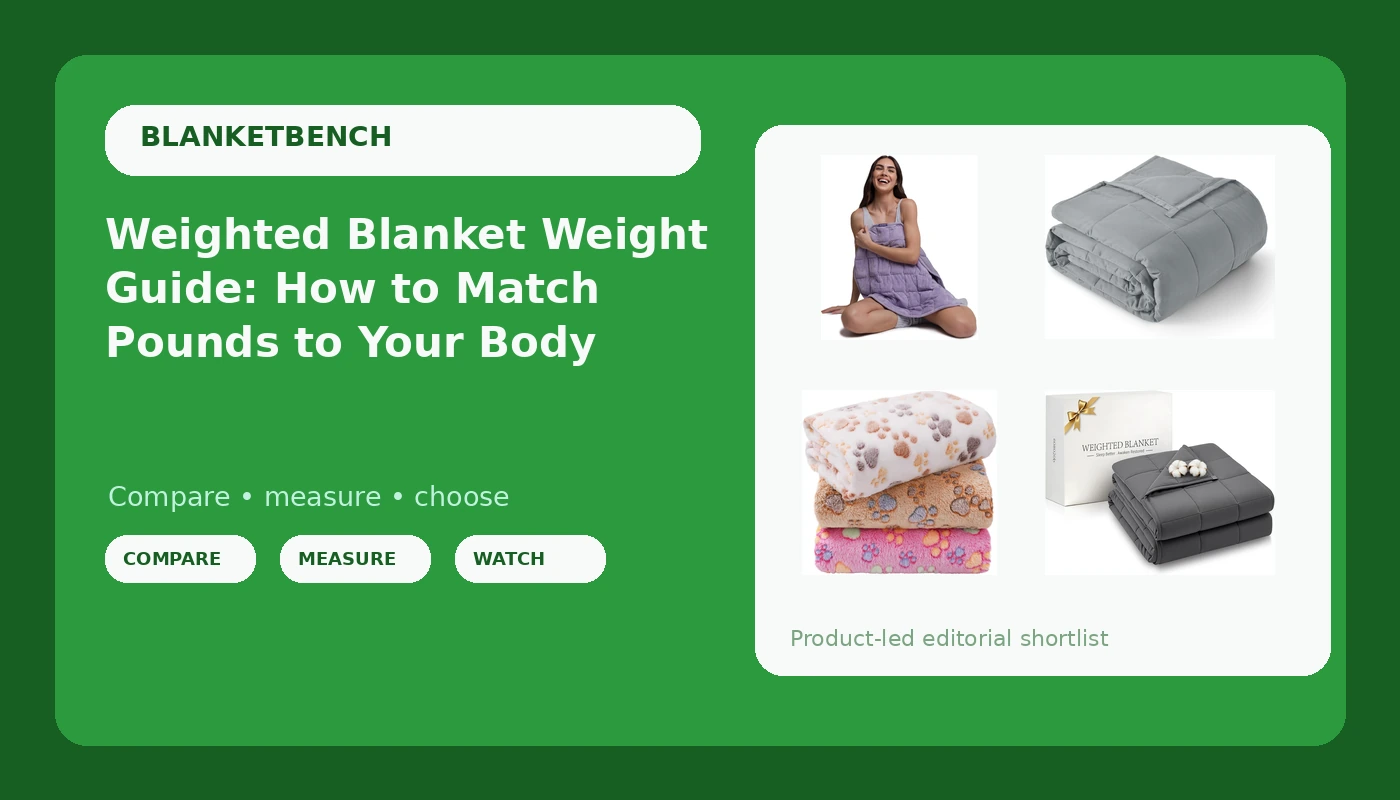
Most shoppers pick a weighted blanket by comparing a single number: pounds. That number is where the decision starts, and it is the least reliable predictor of whether the blanket will still be on your bed by spring. This weighted blanket weight guide covers what the 10 percent guideline does and does not mean, why the shell fabric usually decides whether a blanket gets used or abandoned, and how four very different options fit four very different sleepers. If you have ever bought a heavy blanket, loved it for two weeks, and then moved it permanently to the foot of the bed, the weight was probably not the problem.
Related: Why Your Weighted Blanket Ends Up in the Closet →
Quick answer
Start near 10 percent of your body weight, then adjust based on how the blanket actually feels rather than treating the number as a prescription. For a 150-pound adult that is roughly 15 pounds, and for a 120-pound adult it is roughly 12 pounds, but plenty of people settle a few pounds above or below that range and sleep fine. Size, fill, and shell fabric matter as much as the pound rating, and a blanket you can wash is a blanket you will keep. When you are genuinely torn between two weights, choose the lighter one.
4 useful options
| Model | Best fit | What stands out |
|---|---|---|
| nodpod Body 6.5lb Patented Compact Weighted Blanket | Lap, chair, and couch use, smaller frames, and first-time buyers who want a low weight | The lightest option here, with a stated 6.5 pounds in a compact format |
| Topblan Cooling Weighted Blanket for Adults, 12 lbs 48 x 72 Twin Size Bed | Twin beds and single sleepers in the middle of the weight range | A stated 12 pounds across a 48 x 72 inch twin footprint, built around cooling |
| RJOP Cooling Weighted Blanket for Adults (15lbs, 60x80) Heavy Blanket with Premium Glass, Queen Size Perfect for 190-210 lbs, Soft Breathable, Dark Grey | Queen beds and sleepers the brand sizes for 190 to 210 pounds | A stated 15 pounds across a 60 x 80 inch queen footprint with glass fill |
| LINENLUX Dog Blankets 3-Pack, Super Soft Fluffy Fleece Pet Throw Warm | Pets, not people | A three-pack of fleece pet throws, and not a weighted blanket at all |
The light, compact option: nodpod Body 6.5lb Patented Compact Weighted Blanket
A 6.5 pound blanket sits well below the 10 percent starting point for most adults, and that is the point. Weighted blankets are not only for full-body sleep. They get used on laps during desk work, over legs on the couch, and across the shoulders during a stressful evening, and a lighter blanket is easier to move, easier to fold, and much easier to tolerate if you run warm. The trade-off is straightforward: a compact 6.5 pound blanket will not feel like a full-body hug in a queen bed, and it will not stay put across two sleepers. If your goal is coverage of a whole mattress, this is the wrong shape. If your goal is a low-commitment way to find out whether deep pressure helps you settle, starting light is the smarter experiment.
The mid-weight twin: Topblan Cooling Weighted Blanket for Adults, 12 lbs 48 x 72 Twin Size Bed
Twelve pounds is the number I suggest to a lot of adults who weigh somewhere in the 110 to 140 pound range, and it is also a reasonable choice for heavier sleepers who know they dislike the pinned-down feeling of a heavy blanket. The twin footprint is the real constraint. At 48 x 72 inches this covers one person on a twin or a full bed, and it will look undersized on a queen or king. That is not a defect, it is a specification, and matching it to your mattress matters more than most buyers expect. The cooling angle is worth noting because heat is one of the most common reasons people stop using a weighted blanket, though a cooling label describes how the product is marketed and built, not a guarantee about how you personally will sleep under it.
The heavier queen: RJOP Cooling Weighted Blanket for Adults (15lbs, 60x80) Heavy Blanket with Premium Glass, Queen Size Perfect for 190-210 lbs, Soft Breathable, Dark Grey
This is the option that matches the textbook recommendation most closely: a heavier fill weight over a queen mattress, in the size range where the brand itself names a body weight band. Treat that band as a starting suggestion from the seller, not a clinical threshold. A 190 pound sleeper may find 15 pounds perfect, and a 210 pound sleeper may find it too much after an hour. The honest way to read any body-weight chart on a blanket listing is as a default, and defaults are meant to be overridden by your own experience. The other trade-off is simple physics: more fill weight means more mass to rearrange when you roll over, and it means a heavier load for whatever you sleep on top of. A 15 pound blanket over a queen is a commitment, and it is the right commitment mainly for people who already know they like pressure.
Prices and availability may change. Product images, names, and retailer links must be matched by verified ASIN. Do not state a current price, rating, stock status, or measured result without current evidence.
The one that is not a weighted blanket: LINENLUX Dog Blankets 3-Pack, Super Soft Fluffy Fleece Pet Throw Warm
It is worth being blunt about this one, because it appears in weighted blanket searches and it is not a weighted blanket. A fleece pet throw has no beads, no fill weight, and no deep pressure effect. It is a warm, washable layer for a dog bed, a car seat, or the foot of your own bed if your pet sleeps there. The safety note matters more than the product note: do not put a weighted blanket on a pet or a small child who cannot move it off independently, and do not assume a pet will find pressure calming the way some humans do. If you are shopping for yourself and you want the sensory effect, you need fill. If you are shopping for the dog, a three-pack of fleece throws is a perfectly sensible purchase, just not the one this guide is about.
What the 10 percent guideline actually says
The 10 percent rule is a heuristic, not a prescription. It circulates because it is easy to remember and it produces a reasonable starting number for a lot of people, and it has been repeated so often that many shoppers treat it as a clinical standard. It is not one. The research on weighted blankets is genuinely mixed. Studies tend to be small, short, and reliant on self-reported outcomes like how long it took to fall asleep or how anxious someone felt, and several of the better-designed trials show improvements that are hard to separate from the placebo effect and from the simple comfort of a new bedtime routine.
What the guideline is trying to approximate is proprioceptive input, the sensory feedback your body gets from pressure on muscles and joints. That is the mechanism people describe when they say a weighted blanket feels calming. It is a real sensory experience. Whether it reliably improves sleep across a population is a different and much harder question, and the honest answer is that it seems to help some people and does nothing measurable for others. That is exactly why the number should be a starting point rather than a rule. Start near 10 percent, live with it for a week, and adjust. If you feel trapped, claustrophobic, or overheated, the weight is too high regardless of what any chart says. If it feels like nothing, it is too low.
There is one more practical caveat. The 10 percent figure is usually applied to body weight, but the size of the blanket changes the experience too. Twelve pounds spread across a twin is a different sensation from 12 pounds spread across a king, because the pressure per square inch is lower when the same fill covers more area. That is why two blankets with identical pound ratings can feel completely different, and why the table above lists size next to weight rather than treating weight as the whole story.
Fabric, fill, and why the shell decides the outcome
Weight gets the attention, but the shell fabric is what determines whether a blanket survives past the first month. A weighted blanket that traps heat becomes a blanket you kick off at 2 a.m., and once that happens a few nights in a row, it migrates to the closet. Cooling-oriented shells, breathable weaves, and moisture-wicking covers exist for exactly this reason, and in a place with real summers and real humidity, they are not a luxury feature. They are the difference between a tool and a decoration.
Fill material matters for a related reason. Glass microbeads are dense, which means a blanket can hit a given weight with less bulk, and dense fill tends to shift less than lighter plastic alternatives. Plastic pellets are cheaper and noisier, and they are more prone to migrating if the internal compartments are not sewn tightly. You cannot inspect stitch density from a product photo, but you can read the construction description and you can look at how the fill is compartmentalized. A blanket divided into small quilted squares keeps its weight where it belongs. A blanket with large channels lets everything pool at the edges and the middle, and a blanket that pools is a blanket that feels like a lump rather than a hug.
Washability is the third leg. A weighted blanket that requires a duvet cover to survive cleaning is a blanket with an extra failure point, and a blanket that cannot be machine washed at all is one that will be used carefully for a while and then not at all. Before you buy, read the care instructions and check whether your machine can handle the wet weight of the size you are considering. A 15 pound queen is a very different load for a home washer than a compact 6.5 pound blanket.
- Estimate 10 percent of your body weight, then round to the nearest available fill weight.
- Match the blanket footprint to your mattress: twin for one sleeper on a twin or full, queen for a queen or larger bed.
- Decide whether you run hot. If you do, prioritize a cooling or breathable shell over a heavier fill.
- Check the care instructions and confirm your washing machine can handle that size when wet.
- Buy lighter than your instinct suggests for a first weighted blanket, then size up later if you want more pressure.
Practical guidance before you order
- Weigh the trade-off between weight and mobility: heavier blankets are harder to reposition during the night.
- Read the brand's own body-weight suggestion as a default, not a requirement, and expect to adjust it.
- Look for small, evenly quilted compartments rather than long channels, which is where fill migrates.
- Confirm the return window, because the only reliable test of a weighted blanket is sleeping under it for a week.
- Keep children and pets out of the equation. A weighted blanket should never be used by anyone who cannot remove it independently.
Which option should you choose?
Choose the nodpod Body 6.5lb Patented Compact Weighted Blanket when you want to test whether deep pressure helps you at all, when you plan to use it on a couch or over your lap rather than across a bed, or when you are shopping for a smaller frame that does not need a heavy fill. Choose the Topblan Cooling Weighted Blanket for Adults, 12 lbs 48 x 72 Twin Size Bed when you sleep alone on a twin or full mattress, weigh somewhere in the middle of the adult range, and want a cooling-oriented shell at a moderate stated weight. Choose the RJOP Cooling Weighted Blanket for Adults (15lbs, 60x80) Heavy Blanket with Premium Glass, Queen Size Perfect for 190-210 lbs, Soft Breathable, Dark Grey when you have a queen bed, you already know you like the sensation of a heavier blanket, and the brand's 190 to 210 pound sizing band lines up with your own body weight. Choose the LINENLUX Dog Blankets 3-Pack, Super Soft Fluffy Fleece Pet Throw Warm when the actual sleeper is your dog and you want a soft, washable layer that has nothing to do with deep pressure.
The caveat that applies to all four: the evidence for weighted blankets as a sleep intervention is mixed, the effect people report is often sensory comfort rather than a treated condition, and a blanket is not a substitute for treating an underlying sleep problem. If you are dealing with persistent insomnia or anxiety, a blanket can sit alongside other strategies, not replace them.
The bottom line
The 10 percent guideline is a reasonable place to start and a bad place to stop. Use it to pick a first number, then let your own experience overrule it, because the difference between a blanket you use nightly and one you fold into the closet is usually fabric, size, and washability rather than a pound or two of fill. If you want to start light and low-commitment, the compact nodpod is the low-risk experiment. If you sleep alone on a twin and run warm, the Topblan at a stated 12 pounds is the middle-of-the-road pick. If you have a queen bed and already know you like pressure, the RJOP at a stated 15 pounds is the closest match to the conventional recommendation. And if you came here shopping for your dog, the LINENLUX three-pack is a fine pet throw, just not a weighted blanket.