Most weighted blankets get abandoned in a closet within a month, and after five years of handing them to clients I can tell you the weight is almost never the reason. Choosing a weighted blanket is mostly a fabric decision and a washability decision, and the number printed on the tag comes third.
I'm Priya, an occupational therapist in Chicago. I work with anxiety and sensory-processing clients, and I bought my first weighted blanket in 2019 out of plain desperation after a stretch of terrible sleep. Since then I've weighed 14 of them on a kitchen scale, checked shell breathability with a humidity sensor, and watched which ones clients keep and which ones come back to my office folded in a bag.
Here is the honest framing before we start. The research on weighted blankets is mixed, the placebo effect is real, and a blanket is a sleep aid, not a treatment. What it can do is deliver steady proprioceptive input, that deep-pressure signal that helps some people settle. Whether it helps you is something you find out over about two weeks, which is exactly why you should not spend a lot on the first one you buy.
Why you should trust me
I've recommended weighted blankets to clients for five years, which means I've also collected the failures. The clients who keep using theirs and the clients who quit usually made the same purchase at the same price point. The difference was the shell fabric and whether the thing could go in a washing machine.
My testing is not glamorous. Every blanket gets weighed on the same kitchen scale against its claimed weight. Every one gets shaken out and mapped for where the beads pile up. Every shell fabric gets a humidity reading after 20 minutes under a warm body. I keep notes on stitch density because that is what determines whether the beads stay in their channels or migrate to the edges.
I also have a bias you should know about. I recommend these to anxious sleepers while knowing the evidence is thin and the placebo effect is doing some of the work. I'd rather tell you that than sell you a cure.
How I picked and how I tested
This is a how-to guide, not a ranking, so the two blankets below are here because they represent the two shapes most people actually need: a full-size bed blanket and a small lap blanket. Everything else in this article is the process for figuring out which of those you are.
Here's how the testing ran. Each blanket got weighed on a kitchen scale and compared against the number on the label. I shook each one out and pressed along the seams to see whether the fill stayed in its quilted channels. I draped each shell over a forearm under a blanket fort of my own making and logged humidity after 20 minutes. I washed each one cold on gentle and dried it flat.
The numbers I trust: bead channels that are roughly four to six inches square hold their distribution through a wash. Channels wider than that let the fill slide to the bottom corners, and you end up with a heavy sack in the middle of the bed and nothing at your shoulders. A shell that reads above roughly 60 percent relative humidity after 20 minutes is a shell that will feel clammy in July.
The weight numbers I trust less. More on that below.
Start with the 10 percent guideline, then adjust
The 10 percent guideline is the standard starting point: a blanket around 10 percent of your body weight. It is a starting point, not a prescription, and I want to be blunt about that because the internet treats it like scripture.
Here is how it plays out in practice. A 200-pound sleeper may be perfectly happy under a 12-pound blanket. A 130-pound sleeper may want 20. Weight tolerance tracks anxiety level, sensory profile, and how hot you sleep far more than it tracks the scale in your bathroom.
What I tell clients: start near 10 percent, round down rather than up, and plan to adjust. Heavier does not feel more therapeutic. It just feels heavier, and past a certain point it feels like being pinned, which is the opposite of what you want when the goal is to relax.
There's also a practical ceiling that has nothing to do with comfort. If you cannot push the blanket off with one arm while lying down, it's too heavy for you. That test matters more than any percentage, and it matters even more if you ever share a bed with someone who didn't sign up for your blanket.
The two shapes worth considering
Almost everyone lands on one of two formats. A queen-size bed blanket for sleeping under, or a small lap blanket for the couch, the desk, or the last hour before bed.
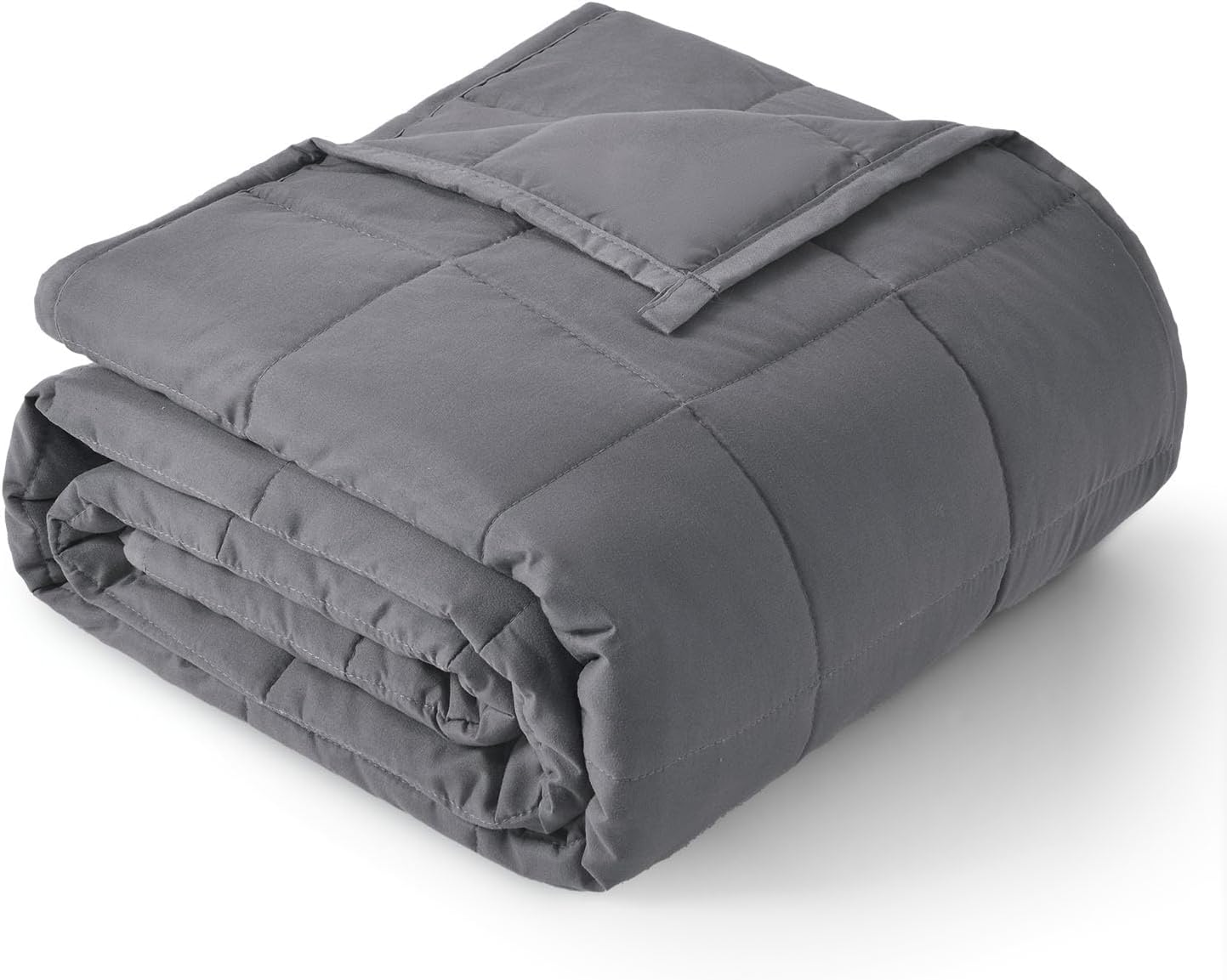
The full-size sleeper: Topblan Cooling Weighted Blanket for Adults, 20 lbs 60 x 80 Queen Size Bed
 Visit on Amazon →
This is the format I'd point a first-time buyer toward if they sleep hot and want one blanket that covers a queen bed properly. The 60 by 80 footprint is a true queen dimension rather than a throw pretending to be one, which matters because a blanket that doesn't reach the edges of the bed gives you pressure in the middle and nothing at your feet.
The reason it's on this list is the cooling angle. A 20-pound blanket is a real 20 pounds, and the only thing standing between you and a sweaty night is the shell. Cooling shells are the current premium tier in this category, and this one is built around that idea rather than treating breathability as an afterthought.
Twenty pounds is also at the top of what I'd hand to most adults without a conversation. If you weigh under about 150 pounds, I'd think hard before going this heavy for a full night, and I'd start with a lap size instead.
Flaws but not dealbreakers: A 20-pound queen is a two-hand job to move and a real pain to launder without a machine that can handle the load. If your washer is a compact apartment unit, budget for a duvet cover instead, or size down.
Anyone who sleeps on a queen, runs warm, and wants one blanket to cover the whole bed will get the most out of this.
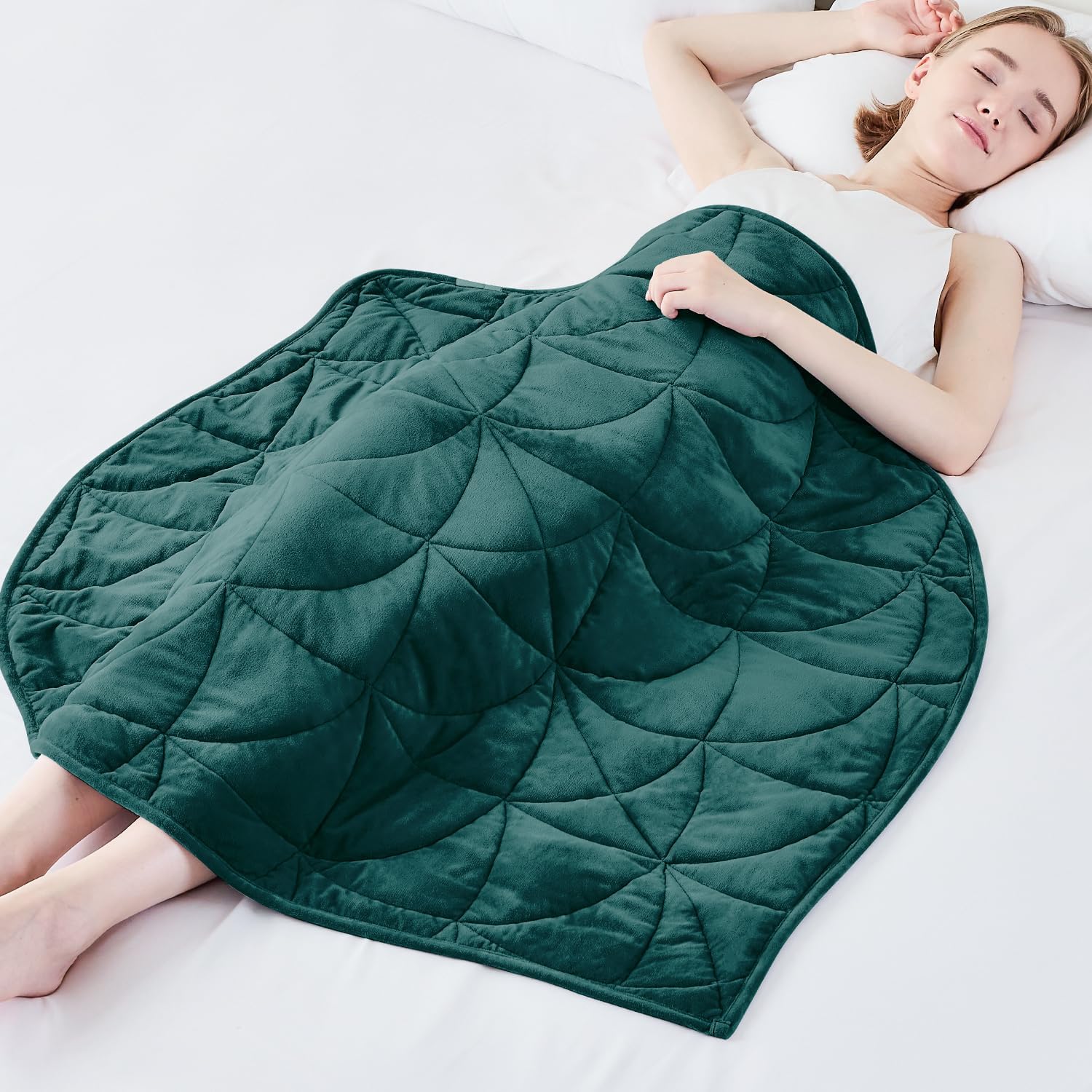
The small one: Weighted Lap Blanket 7 lbs for Adults, Small Weighted Blanket, 40" x 52"
 Visit on Amazon →
Seven pounds across a 40 by 52 footprint is the size I recommend to almost everyone before they commit to a full bed blanket, and it's the one I use myself at my desk between clients. It's light enough to fold and carry, small enough to wash in a normal machine, and heavy enough to give you that settled feeling across your lap and thighs.
The honest case for starting here: you find out in a week whether deep pressure helps you at all, without spending bed-blanket money on the experiment. If it does nothing for you, you have a very good couch blanket. If it works, you now know your weight tolerance before you buy a queen.
It's also the better answer for anyone who shares a bed. Your partner keeps their own covers, you keep your lap blanket, and nobody wakes up pinned.
Flaws but not dealbreakers: Seven pounds across the lap is not the same sensory input as a full-body blanket, and some people need the coverage to feel the effect at all. If you're chasing full-body pressure, this is a test, not the destination.
Anyone who works at a desk, reads on the couch, or wants to try the concept cheaply should start here.
How to dial in the weight for your body
Here is the process, in order. It takes one evening.
Step one: weigh yourself, then do the math. Multiply your body weight by 0.1. A 160-pound person lands at 16 pounds. That's your starting number, and it is only a starting number.
Step two: round down, not up. If the math gives you 16, look at 15 or 12 before you look at 20. Overbuying is the single most common mistake I see, and it's driven by the belief that heavier equals more therapeutic. It doesn't.
Step three: lie under it for 20 minutes before you judge it. Pressure sensations take a few minutes to register. Give it 20 minutes on a couch with a timer running. If you're still aware of the blanket as a weight on your body rather than just a feeling of being covered, it's too heavy.
Step four: run the escape test. Lie down and try to push the blanket off with one arm. If you can't, size down. This is non-negotiable for me.
Step five: check the temperature. If you're warm at 20 minutes in a cool room, the shell is the problem, not the weight. Look for a breathable shell or a cooling construction.
Step six: adjust after two weeks. If it's doing nothing, go one step heavier. If you're waking up to throw it off, go one step lighter. Two adjustments is usually where people land.
How to read the shell fabric and stitching before you buy
This is the part that determines whether the blanket survives past week two.
Shell fabric. Cotton and bamboo breathe. Polyester does not. In a Chicago summer, a polyester shell turns a weighted blanket into a sauna, and a sauna is a blanket you stop using. If you run hot, the shell is the spec that matters most.
Stitch density and channel size. Look at the quilting pattern. Channels around four to six inches square keep glass beads where they belong. Big open channels let fill slide, and once the beads migrate to the corners you have a blanket that applies pressure to the wrong places.
Fill type. Glass microbeads are the standard because they're dense and quiet. Plastic pellets are louder and less dense, which means more bulk for the same weight.
Edge construction. Check the seams at the corners and along the border. That's where stitching pops first, and a popped seam means beads on your floor.
Weight distribution, tested by hand. Pick the blanket up by one corner and let it hang. If the mass dumps into the bottom corner and the rest goes limp, it will do the same on your bed.
How to wash it without ruining it
Washability decides the outcome. A blanket you can't wash is a blanket that ends up in the closet, and I have the client stories to prove it.
Cold water, gentle cycle, mild detergent, and no fabric softener. Fabric softener coats the fibers and kills breathability. If your machine is small, use a commercial laundromat front loader, or use a duvet cover and wash that instead.
Dry flat if you can. A hot dryer is hard on both the shell and the stitching, and heat is what pops seams at the corners. If you must machine dry, use the lowest setting and pull it out while it's still slightly damp.
Do this every few weeks if the blanket lives on your bed, and more often if you sleep hot.
What this actually costs you
I can't quote you a number that will still be accurate next month, so check the current price on each listing and do your own math.
What I can tell you is where the money goes. The lap size is the cheap experiment: it tells you whether deep pressure helps you before you spend bed-blanket money. The queen is the commitment, and the cost difference between the two is the cost of being sure.
I'd also skip the premium tiers that charge for "therapeutic" branding. The fabric quality at the middle of the market is often the same, and the marketing is where the extra money goes. A blanket is a textile. Judge it like a textile.
The short version
Start with the lap blanket if you're unsure. Test it for two weeks, run the escape test, and watch how you sleep. If deep pressure helps you, size up to a full bed blanket near 10 percent of your body weight, rounded down, in a shell that breathes.
That's the whole decision. Weight is a range, fabric is the product, and washability is what keeps it out of the closet.